|
|
• Tuesday, June 1, 2004
Blogger bias as a triumph over mainstream media
It seems to me that traditional journalism has become almost completely stripped of any author bias or personality. Journalists have to deal with editors peering over their shoulders, critiquing their every word and editing out any bit of spice or color. They must also conform to advertiser interests; commercials and advertisements bring in a lot of revenue, and thus many journalists are encouraged, openly or subtly, to respect the interests of ad executives. These two factors have combined to almost completely limit the appearance of authors' personal bias in traditional media. They have also compelled standard reporting to become incredibly bland in my opinion.
 Blogs provide the power to change all of that. With no editors to maintain a choke-hold, bloggers are free to express their opinions as they wish. And with millions of bloggers on the web, nearly every possible perspective can be represented. Those who believe that mainstream media has an overly-liberal slant, such as Andrew Sullivan and Mickey Kaus, can express their more right-wing views in a credible manner and reach thousands of readers in the process. The same is true for those on the left like Joshua Marshall and Markos Moulitsas Zuniga—with no editors breathing down their backs, they are free to add their own opinionated flavor. Not only are these information sources more interesting to read than Blogs provide the power to change all of that. With no editors to maintain a choke-hold, bloggers are free to express their opinions as they wish. And with millions of bloggers on the web, nearly every possible perspective can be represented. Those who believe that mainstream media has an overly-liberal slant, such as Andrew Sullivan and Mickey Kaus, can express their more right-wing views in a credible manner and reach thousands of readers in the process. The same is true for those on the left like Joshua Marshall and Markos Moulitsas Zuniga—with no editors breathing down their backs, they are free to add their own opinionated flavor. Not only are these information sources more interesting to read than 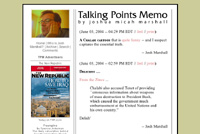 the usual bland news coverage, but their honest and unvarnished quality actually gives readers the ability to develop a more complete picture of the truth. Readers can compile a myriad of candid, unfiltered perspectives on an issue before forming their own opinions. Thus, I believe that blogger bias is a good thing, and it should not be limited by people who are stuck in the shackles of traditional journalistic practice. the usual bland news coverage, but their honest and unvarnished quality actually gives readers the ability to develop a more complete picture of the truth. Readers can compile a myriad of candid, unfiltered perspectives on an issue before forming their own opinions. Thus, I believe that blogger bias is a good thing, and it should not be limited by people who are stuck in the shackles of traditional journalistic practice.
Posted by Bea Lougger at 9:30 PM | 3 comments

Comment #1: Readers are not equipped to handle blogger bias
I agree that blogs are certainly a powerful new tool, and they are changing the way that some people get their information. However, saying that blogger bias is a good thing goes a bit too far. I have two main objections:
- While the blogosphere may provide an increasingly diversified array of opinions, most blog readers maintain a narrow focus on blogs that are already in line with the readers’ own beliefs and perspectives. In theory, people could branch out and engage in the whole spectrum of opinons, but in practice this does not seem to be the case. Instead of providing a more complete truth, blogs help individuals create a more biased, individualized truth, and in this respect the bland old media is at least safer, if not more engaging to the reader.
- Biased blogs are dangerous for the uninitiated. Many readers who are new to blogs may not be aware of the differences between the traditional journalism review process and the unpolished nature of blogs. If these readers approach blogs in the same manner as other media, they could be heavily influenced by authors’ biases. The is also true for young readers; even if they are aware of the differences in approach, they may not realized how slanted the views that they absorb from blogs really are.
I think the diversity of opinion provided in the blogosphere is wonderful, but it is too early to determine how this diversity actually affects readers. If they take advantage of it and understand that blogs reveal the raw, unedited views of the authors, then blogger bias should not be considered harmful. However, based on our limited experience with blogs so far, it is hard for me to believe that readers are fully prepared to deal with blogger bias.
Posted by John Nol at 9:50 PM, Tuesday, June 1, 2004
Comment #2: Focusing on bias misses the real point
I actually disagree with both of the previous statements regarding blogger bias; I think the real virtue of blogs is their ability to reveal straight facts that readers cannot find in the mainstream media. A prime example of this phenomenon occurred last year when most of the American media refused to show photographs and video footage of American prisoners of war that had already been aired on Iraqi television (this New York Times article has more details). People were turning to blogs in order to get information that was completely unfiltered by the press, and I believe this move is indicative of blogs’ true value to readers. Americans want to be able to form their own opinions, and they are tired of diluted and over-hyped television news, so they turn to blogs not to find the opinions of others but to find real facts. Thus, while blogger bias seems like an important topic right now, in the long run people will gravitate towards blogs that provide unbiased facts and in doing so will render this debate irrelevant.
Posted by Rhea D'mee at 10:00 PM, Tuesday, June 1, 2004
Comment #3: A comment on the whole spectrum of opinions
Whether you think blogger bias is a good thing or not, we should all realize that blogs do not represent the whole spectrum of opinions in America. While hosting a blog today may be easier than ever, it still requires a few basic components, including a computer and an internet connection of sufficient speed. Millions of Americans still live without a computer at home, and thus most likely without blogs of their own. The demographics of this group are homogeneous to some extent; they are largely low income, minority households. Until this group can express its voice in the blogosphere, we should take care in lauding a technology that supposedly represents the entire range of American perspectives but is in fact limited by the digital divide.
Posted by E. Cuala Tia at 8:41 PM, Wednesday, June 2, 2004
|