Anonymity and Plurality in the Internet Age The Xbox Case |
| Home | Xbox | HD-DVD | Conclusion | Works Cited | About this Website |
| Introduction | History | Finally Hacked | Homebrew | The Players |
Players AnalysisAs explained before, there exists many ways in which members of the Xbox community contributed to the scene. These members usually navigate different portions of the forums or different chat rooms in IRC, although this is obviously not a rule of thumb. These groups of people have different motivations, intentions, and interactions with the scene.
Avant-garde HackersThese are the people who bring most of the breakthroughs regarding the breaching of the Xbox’s security system. They usually have a deeper understanding on hardware architecture or software than the regular users and, with their knowledge, hack security flaws in the system using methods like reverse engineering. Although not always true, these hackers are usually detached from the console as a gaming machine and are interested mainly at how it’s engineered. Some of these people, like Andrew “bunnie” Huang, often make recommendations on how to strengthen security to Hardware manufacturing companies. To give the user an idea of how well prepared these avant-garde hackers are, here’s an excerpt on Huang’s “Keeping Secrets in Hardware: the Microsoft XBox™ Case Study:”
These people’s motivations are almost purely educational. For them, it is a personal challenge to see how far they can take their knowledge and find flaws in said systems. They usually “hang-out” in secluded parts of the community like private forums or separate chat rooms, where they can discuss their findings without having the newbies disturb them. Since they do really know quite a lot about electronics and software, they rarely want to spend time explaining their findings to people that are not on par. There are usually very few of these hackers, and although they rely heavily on each other’s work, it is usually one or two that do most of the work and finally breach the security systems. Since they are usually people with higher education degrees, these people tend to be very careful with the type of information they share and are usually very responsive and caring towards the law. Since they don’t engage in illegal activities, they are often less worried with concealing their identity. Although not all share their personal information, many are the exception to anonymity in the Xbox community. For reference, Andrew “bunnie” Huang was asked to remove a piece of code Microsoft believed to be copyrighted, and did so ipso facto. Here is a link to a message Microsoft left on his answering machine just 12 hours after he had posted the code on his personal webpage.
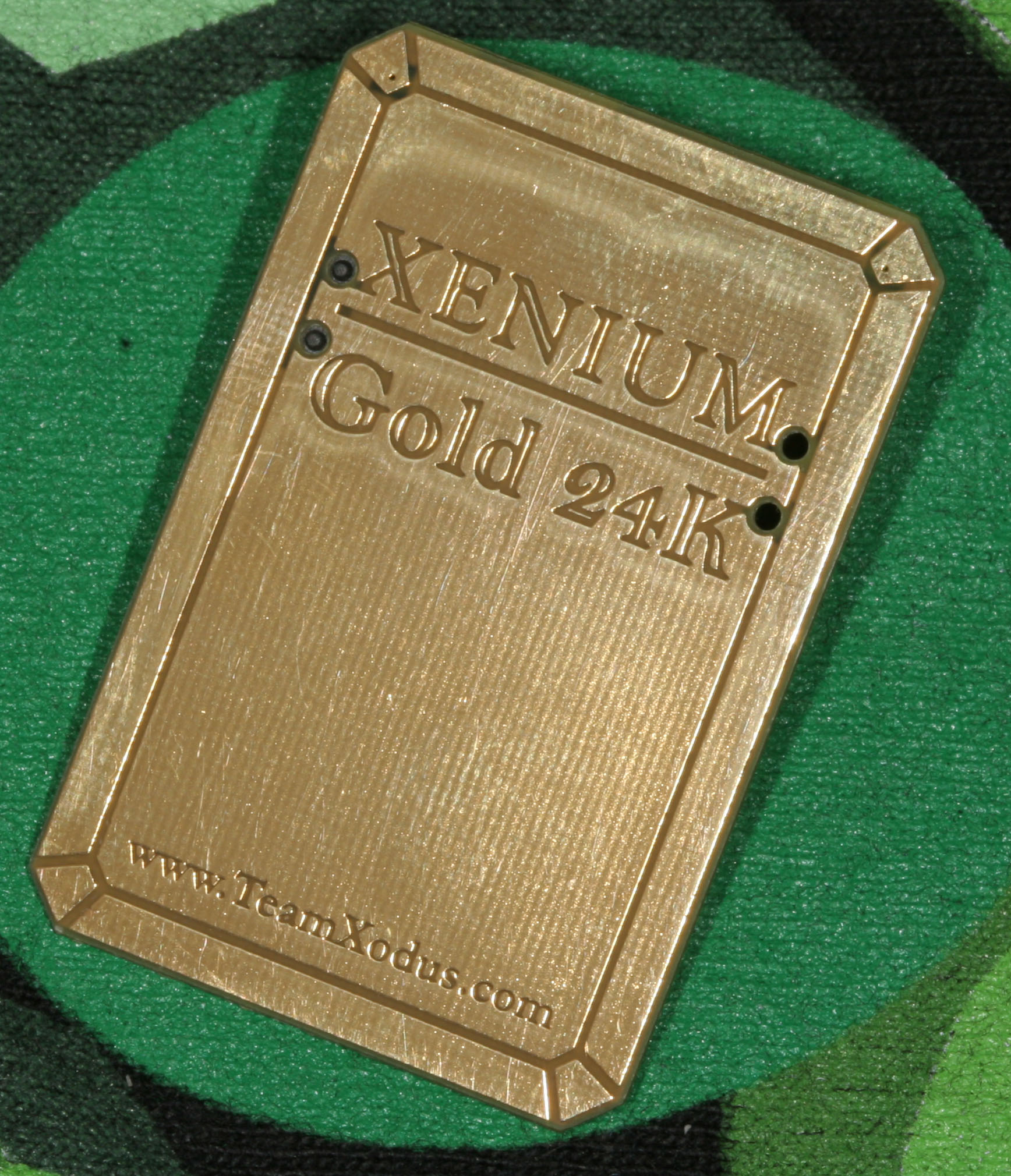
Modchip ManufacturersModchip manufacturers are touchy ground for many in the Xbox community. These are the only members that make a profit, and often do so by stealing (or using, like they like to say) the findings of the avant-garde hackers. They have the capability of mass-producing and distributing the chips that are required to hack gaming consoles, which provide an advantage for the majority of the people in the scene which don’t have access to the materials needed to build these chips. Since modchip producers compete with each other and many modders are at their mercy to hack their Xboxes, they try to better their image by investing time in further developing the intensity at which gaming consoles are hacked. Modchip producers are often responsible for very cool hacks, like the ability to swap the 5GB hard drive for a 250GB one. Other marketing strategies include selling modchips with a 24K Gold covering layer, like Team Xenium’s Gold.
Team Xenium's "Gold" Modchip, covered with a layer of 24K Gold.
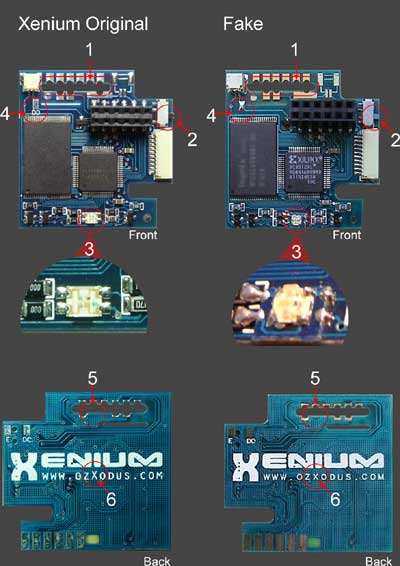
One would think that producing modchips that allow Xbox users to boot backups is as pirate as one could go, but that’s not true. Several Xbox modchip producers have been victims of fakes; pirated versions of their chips that looked almost identical to the real ones. The scene got very upset with the appearance of these chips that not only failed, but sometimes also damaged Xboxes.
Homebrew developersThese groups of people have very divided interests and work on different projects, like the ones already discussed. Particularly interesting is that most homebrew developers work in groups of people geographically dispersed and sometimes work on projects 24 hours. These groups are often very small, usually not exceeding five people. They either invested time working in projects that interested them or on ones they had worked on before for other platforms. The latter case includes many groups that had programmed console emulators for PC and where now porting them to the Xbox. This group of people is mainly composed of hobbyists who simply want to make the Xbox experience be different than any other consoles’ hacking. During its early stages, programming homebrew required programmers to use a tiny code copyrighted by Microsoft. This prevented homebrew software to be posted on Xbox-Scene.com for download, but the page still reported on their progress. Even though they were using copyrighted code, it was rather insignificant compared to the rest of the program, and it was only used because it was needed in order to run the software on the Xbox. Later developments on the Xbox hacking scene allowed homebrew to be run using an open-source equivalent to the Microsoft copyrighted code, and many homebrew developers changed their programs to use this new open-source code. However, most didn’t care and continue programming based on the Microsoft code. A software developer that wished to remain anonymous thinks that homebrew software, running with the Microsoft copyrighted code or not, “is not illegal or at least it should not be.” The programmers of homebrew software do not receive any compensation except recognition from other scene members for the time and energy they invest developing their codes. They do it out of interest, fun, and excitement. Some of these people think about the scene as a job. DrPepperF, a 16 year old software programmer who was tracked by the FBI and had a major Xbox website shut down due to illegal content reports on the time he dedicated each week to this virtual community: “Put it this way. It’s like work… I spend almost every hour to it.” When asked about his motivations he responded: “I’d say it was a hobby, how much I did would be an obsession actually.” An interesting piece of history worth mentioning is the creation of homebrew “tunneling” software, which allowed people to play multiplayer games over the Internet. This was similar to Xbox Live, a service launched by Microsoft that allowed people to play games on-line and compete with one another. This homebrew software became really popular when Microsoft came up with a way of detecting modified Xboxes on their Xbox Live servers and started banning those machines. People simply moved to the homebrew system which, although less popular than the Xbox Live servers, was filled with hardcore gamers and provided a fairly competitive atmosphere.
XBConnect, one of several tunneling softwares programmed for the Xbox. Click on the picture for a higher resolution image of an XBC Game room.
Pirated Games Release GroupsAs already mentioned, release groups started making available copies of games on the Internet even before the Xbox was hacked. With each release, they write up a so-called nfo file, which is nothing more than an information file. Although these files don’t have a set structure, they often have information on the release (such as size, what it contains, etc…), a description of the game itself, installation instructions, and greetings. Sometimes they include other things like mission statements, messages for the scene, or bashing of other groups (this generally happens after another group makes a release that is faulty). A typical nfo file looks like this. Release groups are particularly interested in people that have access to unreleased software like magazine publishers or game distributors. On this nfo file, the release group CSiSO asks for such people. Just below their recruitment section, they send out greetings to other groups, acknowledging them for their work. The release groups usually simply distribute their software to a very few people, who are in charge of further distribution (these are called “fillers”). The activity of ripping games and distributing them over the Internet is highly illegal and as a result, release group members are extremely confidential and they compose of the most underground members in the community. Release group’s motivations vary and they’ve released software for years under different excuses. At the beginning some of the groups claimed they were ripping software in order to give avant-garde hackers with media to test their hacking attempts. However, groups that were releasing games under this pretense kept releasing games long after people had successfully achieved to crack the Xbox’s security system. Team Ritual has an interesting mission statement on one of their nfos:
On to HD-DVD Case |
| Copyright © 2007 Daniel Vogel & Daniel Espinosa. All rights reserved. |