NSA Wiretapping
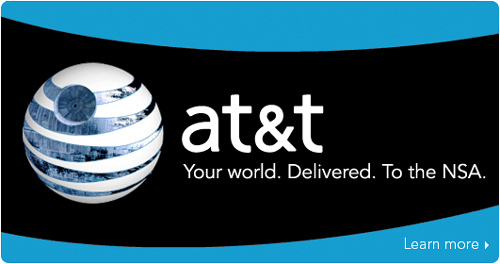
An image created during the outcry that followed the breaking of the wiretap case.
CC Attribution-Noncommercial 2.0 by lawgeek
The Issue
Shortly after September 11, 2001, President Bush authorized taps on domestic phone calls and email, as well as "data mining," a technique that allows the government to sift through vast quantities of user's personal information. Through partnerships with the FBI, US Treasury and a number of private businesses (such as AT&T), the NSA was able to gain broad access to most major forms of communication.
As might be expected, when the public was briefed about the wiretapping, a tremendous uproar ensued. Many of those angered by the wiretaps argued that such activities were illegal. These accusations were given credibility by a report of the Congressional Research Service, a non-partisan investigatory agency, which stated that a number of the NSA's activities were either unconstitutional or unlawful. In particular, the report argued that NSA's actions ignored the intent of the Foreign Intelligence Surveillance Act of 1978, which designates procedures for collecting "foreign intelligence information."
Applicability of Lessig's Thesis
Concepts from Code and Other Laws of Cyberspace apply in a number of ways. Lessig argues that government regulation is necessary for the preservation of free speech, privacy, and security. In this he relies on his experience with the trials and tribulations of ex-Soviet republics as libertarian and anarchistic elements attempted to experimented to little avail. He also talks a great deal about the basis of expectations of privacy, which came to the fore in the wiretapping case. Therefore, the NSA's wiretapping raises a few questions. The presumption is that the goal of the taps were to make the United States more secure against terrorism. So we might first ask where the expectation of privacy, which is in this instance diametrically opposed to making the US safer, arose from, and whether we can fit it into the model of regulation generation.
The obvious place to start is with social norms. Words associated with invasion of privacy are primarily emotional: a privacy invader is creepy, someone who has had their privacy invaded feels violated, and we generally think an offense has been committed even if the transgressor hasn't learned incriminating information. However, we can't legislate emotion, and it turns out that right to privacy has been the subject of much debate, some of which Lessig covers in Code. In the original Prohibition-era Supreme Court decision on wiretapping, Olmstead v. United States, the NSA would have gotten away scott-free. The original means of enforcing privacy was through the use of a preexisting legal mechanism: the trespass statutes. Before wiretapping, gathering evidence generally required entering private property. Therefore, a warrant was required to protect a police officer from possible trespassing charges. However, this obviously didn't apply in the case of wiretapping, since no trespass was necessary. This formed one side of the debate. The other side argued that the intent of the fourth amendment as a protection of privacy in general was clear, and that the intent of the law should be followed rather than its letter. The majority in Olmstead found that there was no inherent right to privacy past the adaptation of trespass laws, and as such, no warrant was required for wiretapping. This was not reversed until 1967, when Katz v. United States affirmed that the Fourth Amendment does guarantee a right to privacy inclusive of telephone conversations.
The primary change between the two cases was social norms of the time: whereas in the 1920s phones were a novelty, so the legislative fourth of the model was content with the preexisting legal and architectural features, by the 1960s phone conversation had become similar in the general public's mind to face-to-face conversation, which had reasonable protection. Therefore, the back-and-forth bebetween the legal and social aspects of the model come together nicely in the case of wiretapping. Therefore, it makes a great deal of sense to survey the four forces, and try to predict the future of wiretapping.
Analysis of the NSA Case
Although the NSA case seems to be a denunciation of Lessig's views that government regulation will secure free speech and privacy, it can be just as easily be viewed as an affirmation of the effectiveness of his model. We might ask why the telecom companies would comply with a request of dubious legality. For the answer, we need only look at the influence of the market. Quite simply, it's bad business to say no to the government. In this case Qwest was one such company, and now their former CEO alleges that they were punished for it.
However, we could imagine a regulatory system that changed the market such that the penalties for companies giving information away without a valid warrant would make it only rational to present a unified front against such illegal requests. But in order for that to happen, we would need to shift either social norms (in order to make it palatable for elected lawmakers to pass a law that could be construed as being weak on terrorism) or the architecture of the system (e.g. to a peer-to-peer based VoIP system that would make it harder to tap the phone lines covertly). In order to effect change, many elements of the model must be involved. It's worth noting as an addendum that although the tendency is strong to simply blame a corrupted or co-opted legal system for the warrantless wiretapping debacle, the invaders of privacy could just as easily have been private corporations (of which there are any) who were aggregating data and mining information of of cyberspace users, the public would be relatively powerless to stop these businesses without government intervention. Thus this issue, like the others mentioned on this website, primarily highlights a need for all spheres (Physical, Legal, Social and Markets) to counter-act one another to produce a stable, neutral, and secure network.