 |
 |
 |
 |
 |
 |
 |

The Supermarine Spitfire
OVERVIEW
The prototype for the Spitfire was a plane labeled K5054, and it made its appearance in March of 1936. It was the result of the same motivation for development as had prompted Hawker to design the Hurricane. It was clear war was approaching, and Britain wanted to be prepared for it. K5054 was an immensely useful machine. This single aircraft was altered as each improvement was suggested, then tested for the effect of each alteration.
From the first, pilots noted the proto-Spitfire’s excellent handling. Its reputation grew from the first flight, when pilot “Mutt” Summers landed and said, “I don’t want anything touched.” He meant that though the flight had gone well, nothing should be altered until further testing. However, word spread that the new plane was something special.
THE NEED FOR SPEED
Speed was the major goal of those working on the Spitfire. It was the cause of almost all its adaptations. It was particularly urgent as an advantage in competition with the Hurricane. The Hurricane was available to the military first, and Supermarine’s workers needed to prove their machine was equally necessary, or all their privately-funded work would not pay off with a government order. Since the Spitfire was using a Merlin engine, just as the Hurricane was, the increase in speed had to come from other areas.
EARLY MODIFICATIONS
PRACTICAL PROBLEMS
A major practical flaw appeared when testing the 8 mounted guns on the plane. At high altitudes, the guns would freeze up, preventing some or all from firing. Even more distressing, they would then release the pent-up ammunition once back on the ground. The solution, which went through several incarnations, was to run hot air from the engine by the guns, thus keeping them warm enough to operate at any height. They later attempted to add heavier guns, more capable of piercing an enemy’s armor. However, the only place they could be squeezed into the design was on their sides on the wings, where any serious G-force would cause the guns to jam. The cannon Spitfire project was abandoned.
The high speed of the Spitfire introduced the problem of G forces in aviation. As a simple solution, the pilot had two-step rudder pedals. Normally his feet rested on the lower set, but when about to pull high G’s, he raised them to the upper steps. This increased his resistance to blacking out. Another simple alteration was the addition of a wheel on the tail. Previously, the tail had been designed to skid until the plane stopped. However, with runways becoming increasingly paved, this would not have been a pretty sight.
Just like its counterpart, the Spitfire was in a constant state of evolution. It continued so into the Cold War, ever advancing its technology and adapting to its mission, whether it was adding friend-or-foe identification transmitters or adapting to postwar surveillance.

Source: http//www.flyvintage.com/aircraft/0/33/
The plane that became the Spitfire was a more complex aircraft than the Hurricane. It was more advanced, and in its refined state it was faster. Certainly it was more maneuverable, which was an asset in combat against German fighters. The tradeoff was that Spitfires were not as easy to repair and send back into the air as Hurricanes.
The first alteration in K5054 was to change its propeller. The pitch of a propeller measures how big an angle it makes against the air. A fine-pitch propeller slices through the air easily enough due to its low blade angle. It will spin around many times per minute, but it will not push much air through, so the airspeed it gives is low. It’s like swimming freestyle without cupping your hands. This is the type of propeller that K5054 initially had. After the first flight, it received a prop with a greater pitch angle. The result was more speed.
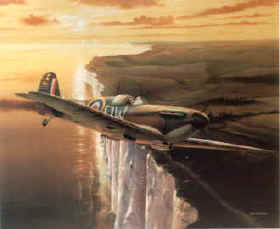
Source: http://www.aviationartprints.com/spitfire_fighter_aircraft.htm
In May of 1936, the Spitfire could only boast a 5mph lead over the Hurricane (335mph compared to 330mph). The propeller required further tweaking over time, first altering its tips, then changing to a metal 3-bladed metal prop from the 2-bladed wooden design. The rudder proved too sensitive at high speeds, so it had to be somewhat squared off on top. In addition, engineers discovered that if the plane were to reach 380mph, the wings would flutter dangerously. They corrected the problem in manufacturing plans, but let it remain on their test vehicle. The government was sufficiently impressed, and ordered 310 Spitfires to be manufactured.
The matter of manufacturing brought up another question. K5054 had been put together entirely with flush riveting, so that the surface was completely smooth. This method was more expensive than dome-headed rivets, however. To test where the cheaper rivets could be used without significant losses in performance, the company glued split peas to the flush rivets in various locations, then tested the resulting change in speed. As a result of these tests, rounded rivets were used “in fore and aft rows attaching the fuselage plates.”

Source: http//www.supermarine-spitfire.co.uk/spitfire.html