|
History
In 1976, computer science
professors from the University of Oregon bemoaned the state of computer
science in secondary education. Specifically, although almost all states
had high percentages of schools that have instructional computing facilities,
the majority of students were not using these facilities in any significant
way. In addition, they found that most schools "have no staff with
a good working knowledge of computers (say the equivalent of a bachelor's
degree in the field)" (Moursund). The professors also emphasized
the lack of appropriate lower level textbooks for teaching computer
science. More than 30 years later, their findings are still very relevant
and topical. The lack of progress during this time is alarming, and
might be a contributing factor to the decreasing number of college computer
science majors.
It was perhaps in response
to University of Oregon article and others like it that the 80s and
early 90s showed a huge flurry of research activity into early acquisition
of computer science. Most of the research material for this project
comes from those papers. Unfortunately, due perhaps to the development
of more advanced teaching applications that do not involve programming
and teachers' general hesitance to adopt the rigorous study of computer
science into their lesson plans, it appears that research in this area
has significantly diminished in the last decade, as indicated by a rapid
decline of papers published on the subject in the last 15 years. For
this reason, discussion of the history of studies into the early acquisition
of computer science is mostly limited to activity that occurred in the
80s and early 90s.
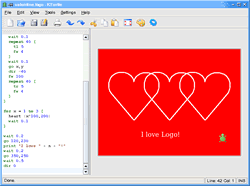 The
Logo programming language was the tool used to conduct the first serious
explorations of computer science acquisition in primary and secondary
schools. Logo was created by Seymour Papert and Wally Feurzig in 1967.
The language was designed to teach programming concepts and to enhance
critical thinking skills. The original idea was Logo could be used to
teach students both mathematical and programming concepts concurrently.
It was quickly discovered, however, that Logo could be used in conjunction
with work in subject areas outside mathematics. Thus, Logo became the
general "language for learning" for early computer programming
curricula. Logo's main strength lied in its simple and intuitive syntax
and interface, which appealed to younger computer users. In the 80s
and early 90s, a number of education and computer science labs carried
out research relating to Logo's capabilities as a teaching tool. For
the most part, this research involved teaching Logo to young children
and educating secondary school teachers to teach Logo. The results were
conclusively positive, with numerous success
stories and positive study results. Despite
this encouraging fact, Logo did not catch on as language to teach computer
science at secondary schools, at least not in terms of a nationwide
effort. In addition, very few alternative environments and programming
languages for the same task were developed. The ones that were developed
(like ToonTalk for example) never reached Logo's limited use and popularity. The
Logo programming language was the tool used to conduct the first serious
explorations of computer science acquisition in primary and secondary
schools. Logo was created by Seymour Papert and Wally Feurzig in 1967.
The language was designed to teach programming concepts and to enhance
critical thinking skills. The original idea was Logo could be used to
teach students both mathematical and programming concepts concurrently.
It was quickly discovered, however, that Logo could be used in conjunction
with work in subject areas outside mathematics. Thus, Logo became the
general "language for learning" for early computer programming
curricula. Logo's main strength lied in its simple and intuitive syntax
and interface, which appealed to younger computer users. In the 80s
and early 90s, a number of education and computer science labs carried
out research relating to Logo's capabilities as a teaching tool. For
the most part, this research involved teaching Logo to young children
and educating secondary school teachers to teach Logo. The results were
conclusively positive, with numerous success
stories and positive study results. Despite
this encouraging fact, Logo did not catch on as language to teach computer
science at secondary schools, at least not in terms of a nationwide
effort. In addition, very few alternative environments and programming
languages for the same task were developed. The ones that were developed
(like ToonTalk for example) never reached Logo's limited use and popularity.
The only other language to
garner popularity for teaching computer science to young children was
BASIC, which stands for Beginner's All-purpose Symbolic Instruction
Code. Designed in 1963 (4 years before Logo) by John Kemeny and Thomas
Kurtz at Dartmouth College, like Logo, the goal of BASIC was for non-computer
science students to learn programming concepts.
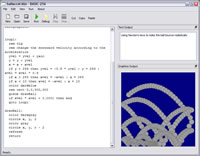 There
still are projects that focus on BASIC and Logo as tools to teach rudimentary
programming skills. For example, the BASIC-256 project focused on the
design of "an easy to use version of BASIC designed to teach young
children the basics of computer programming. It uses traditional control
structures like gosub, for/next, and goto, which helps kids easily see
how program flow-control works. It has a built-in graphics mode which
lets them draw pictures on screen in minutes, and a set of detailed,
easy-to-follow tutorials that introduce programming concepts through
fun exercises" ("Basic-256 - Programming for kids;" see
the screenshot on the left). Unfortunately, projects involving Logo,
BASIC, or most other programming languages intended to teach computer
science to younger students have received little attention by educators
and administrators. There
still are projects that focus on BASIC and Logo as tools to teach rudimentary
programming skills. For example, the BASIC-256 project focused on the
design of "an easy to use version of BASIC designed to teach young
children the basics of computer programming. It uses traditional control
structures like gosub, for/next, and goto, which helps kids easily see
how program flow-control works. It has a built-in graphics mode which
lets them draw pictures on screen in minutes, and a set of detailed,
easy-to-follow tutorials that introduce programming concepts through
fun exercises" ("Basic-256 - Programming for kids;" see
the screenshot on the left). Unfortunately, projects involving Logo,
BASIC, or most other programming languages intended to teach computer
science to younger students have received little attention by educators
and administrators.
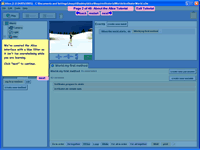 More
recent efforts have resulted in programming languages with simpler interfaces
and syntax. For instance, the Alice project created a fully-graphical
interface for programming in which students simply drag and drop behaviors
for characters in a scene (see the image on the right). While these
applications certainly show promise in removing unnecessary difficulty
from simple programming, none has gained much attention in classrooms
outside teaching laboratories. More
recent efforts have resulted in programming languages with simpler interfaces
and syntax. For instance, the Alice project created a fully-graphical
interface for programming in which students simply drag and drop behaviors
for characters in a scene (see the image on the right). While these
applications certainly show promise in removing unnecessary difficulty
from simple programming, none has gained much attention in classrooms
outside teaching laboratories.
For more detailed information
on the history of Logo and the current research, visit the MIT
Logo Foundation website.
|


