
CS 201 Final Project
|
|
Megan Bela, Ruth Costa, Michael Lyubomirskiy, Andre Pech |


|
The Future of Education Onlineó Online Distance Education |
|
http://www.avu.org/technology.asp Because online education can leap over geographic barriers and eliminate the need for costly physical infrastructure, it has been lauded in particular as a solution to the general lack of quality higher education in the developing world.Ý However, in addition to the issues of pedagogical and technical effectiveness found in any online program, distance education in developing countries faces unique obstacles. Economists have identified investment in human capital ñ education and training of the workforce ñ as an essential ingredient for economic growth.Ý While the importance of primary and secondary education in training literate, productive citizens is obvious, it is higher education that produces the doctors, lawyers, engineers, policy-makers and business managers who drive innovation and economic progress.Ý The World Bank has identified a severe lack of quality higher education in developing countries as a major obstacle to economic development (Kuroda and Shanawez, 2004). In the 1960s and 1970s, the newly independent African countries, riding on the promise of Western technology, launched a series of distance education programs via television and radio developed by American universities.Ý All the programs failed within a decade largely due to lack of cultural understanding by the foreign developers, Africaís poor communications infrastructure, and difficulties of students whose native language was not English (Sy, 2004).Ý The introduction of personal computers in the 1980s and the birth of the World Wide Web in the 1990s sparked a new surge of interest in using internet courses to ìleapfrogî the lack of academic infrastructure in developing countries. ÝÝÝÝÝÝÝÝÝÝÝÝ ÝÝÝÝÝÝÝÝÝÝÝÝ While technology may have improved, many of the same social issues remain: (1) equality of access to the internet and the online program; (3) cultural and language barriers; and (4) eliminating dependence on American and European universities through knowledge production.Ý (links to bold-headed sections below through underlines phrases) Equality of Access
Internet Access
Accessibility of the internet is significantly lower in Africa and Asia than in the United States; the most recent available country-level data shows that 7% of South Africans, 4% of Chinese, 2% of Indonesians, and less than 1% of Subsaharan Africans have internet access.Ý This compares with over 60% in the United States (http://www.nua.ie/surveys/how_many_online/n_america.html).Ý The reasons for this disparity are primarily economic; according to 2003 figures, the average cost in Africa of 20 hours per month of dialup Internet was $60, exceeding the average monthly income (Colle and Roman).Ý Clearly, the cost of owning an individual computer and internet account is out of reach for most Africans; thus government-sponsored community telecentres, particularly ones that permit payment in goods and services rather than cash, are rapidly spreading as the most effective ways to increase access.Ý Thus, online education programs based at centrally located centers are likely to reach more people, although access will still be skewed towards those living in urban areas. Cost of Online Education
Higher education is significantly more expensive than primary or secondary school ñ one study in East Africa estimated that costs were 50 times higher (Kuroda and Shanawez, 2004), largely due to lower student/teacher ratios, lower teaching time per teacher, and higher physical equipment costs.Ý One of the rationales for online higher education is to reduce physical equipment costs and spread the costs of program development and instructors over a larger number of students.Ý Costs of maintaining information databases can also be spread over many users or institutions; for examples, the African Virtual University (AVU), sponsored by the World Bank, offers access at an annual flat rate to a joint digital library of 22 universities in 16 Sub-Saharan countries. The investment cost of the communications infrastructure and computer hardware can be a major obstacle for developing countries, since online initiatives may introduce the first high-speed internet in a country.Ý Perhaps as significant an obstacle is the lack of trained personnel to manage the communications infrastructure and computer hardware; for this reason, the AVU offers degree programs in computer science and short courses in IT to train the next generation of program developers. ÝÝÝÝÝÝÝÝÝÝÝÝ ÝÝÝÝÝÝÝÝÝÝÝÝ Government incentives, such as tax-exemptions for education investments, are likely needed to encourage telecommunications companies to expand access and provide reduced pricing for higher education initiatives. Example: The African Virtual University
The African Virtual University (http://www.avu.org/default.asp) was created in 1997 as a World Bank project, and due to its success in the pilot phase has now been transferred to an NGO based in Nairobi.Ý The rationale for the AVU is to address a severe shortage of quality higher education in Africa, due to the following factors: Insufficient spaces in the higher education system to accommodate the number of high school graduates who wish to enroll ìOverstretchedî government budgets due to competing demands for funds, including other social programs and foreign debt Overly expensive private college education A large labor force that needs college-level skills in computing and business to bring Africa into the ìGlobal Knowledge Societyî
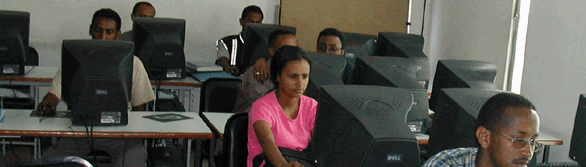
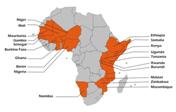
Students participate in an online course at one of the African Virtual University learning centers. http://www.avu.org/instructional_design.asp ÝÝÝÝÝÝÝÝÝÝÝÝ ÝÝÝÝÝÝÝÝÝÝÝÝ The AVU offers degree programs in computer science and business through Canadian and Australian universities, as well as short courses in journalism and IT through several American universities.Ý Students must attend courses at a learning centers in one of 20 African countries; although there are onsite tutors and facilitators, All the material is delivered through satellite or the internet.Ý Tuition costs are not available at the AVU website does not list tuition costs, but it can be assumed that enrollment is effectively limited to those who can access the learning centers in country capitals. Cultural and Language Barriers Currently, international online courses are typically developed by American or European educators for African or Asian students.Ý Thus, careful attention needs to be paid to cultural differences in expression and learning style, especially in interactive discussion.Ý Intercultural communication is a well-studied field because of its necessity in international business, and online course designers should make sure to incorporate these principles.Ý To illustrate how cultural values, and thus effective pedagogical techniques, may vary by region, examples from Asia and Africa are presented below. Cultural Concerns in Africa
Although Africa is a diverse continent, its cultural values are often summarized by the Zulu principle of Ubuntu, or sharing.Ý Traditional African governance is based upon constructive disagreement and discussion (not competitive debate, as it is often interpreted in the West) until consensus is reached.Ý Respect for elders and the interdependence of the community is also important.Ý Thus, online courses for African students may be more effective if based on group consensus of learning goals and cooperative projects (Heydenrych et al., 2004). Cultural Concerns in Asia
The university infrastructure in Asia is more developed than in Africa, and so online initiatives tend to be collaborations between Asian and American universities, supplementing rather than replacing traditional courses.Ý An example of this was featured in a study by Shih and Cifuentes (2003), enrolling 40 American students to provide tutoring in English and American culture to 40 Taiwanese students.Ý Hofstede (1986) identified key Taiwanese cultural values, including indirect, high-context communication, collectivism rather than individualism, preference for structured situations, and power distance between older and younger persons.Ý These values were reflected in the disparate experiences of Taiwanese and American students. The American students were frustrated by what they perceived to be a lack of communication from the Taiwanese students, who preferred one-on-one contact with group members and tutors to avoid losing face in front of a large group, and hesitated to clarify language misunderstanding to avoid conflict.Ý The Americans were confused by what seemed to them to be excessive humility and expressions of gratitude.Ý Conversely, the Taiwanese students perceived the directness of the comments of their tutor to be ìrude,î and expected a more structured transfer of knowledge from their ìsageî tutors.Ý ÝÝÝÝÝÝÝÝÝÝÝÝ ÝÝÝÝÝÝÝÝÝÝÝÝ Encouraging Asian students to self-assess their progress could help them deal with the lack of structure, and adding visual communication (through pictures) could help reduce language misunderstandings.
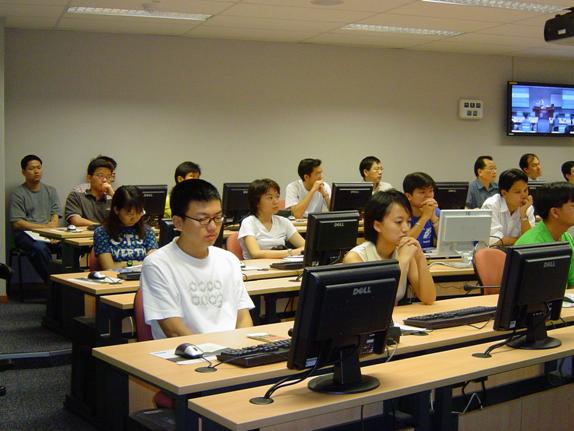
Students at the Nanyang Technological University in Singapore take a distance course in environmental engineering through the Stanford Singapore Partnership http://www.ntu.edu.sg/cee/ssp/SSP_Gallery/images/DSC00490.JPG Knowledge Production Promoters of online education in Africa argue that Africa missed the industrial revolution, and is in danger of missing the information revolution.Ý The internet may be an effective way to ìleapfrogî the high cost of university infrastructure; however, care should be taken to train future software and curriculum developers so that countries can eventually be self-sufficient from their American and Europeans sponsors.Ý Additionally, improved telecommunication and information links should be developed between countries within a region, preserving the crucial role of universities as centers for development and dissemination of local knowledge. |




|
South African Telecenter |
|
African countries with AVU learning centers http:///www.avu.org/learning_centers.asp |