One Chord, Three Names: What Maiden Voyage Taught Me About Sus Chords
Brando Miranda — September 2026 · ~8 min read
TL;DR. I sat down with two versions of Herbie Hancock’s Maiden Voyage — the Aebersold play-along and Jim Snidero’s etude Voyage — plus lesson notes from two teachers, and they seemed to disagree about the very first chord. They don’t. F#-/B, B7sus, F# Dorian, B Mixolydian, “E pent / A pent,” and “B bebop” are the same seven notes of E major named from different roots. The chord has no third, so it never commits to major or minor, and that is why so many names fit it. The upshot: over a sus chord the natural fourth is the chord, so Mixolydian is the default and Lydian dominant is off the table — and a modal tune is a chain of short keys, four bars each.
Two books, one tune, an apparent contradiction
I’ve been working through Jim Snidero’s Jazz Conception on alto, and the etude Voyage runs over the changes of Maiden Voyage: B7sus for four bars, D7sus for four, back and forth, then a bridge of C7sus and Bb-13, then home. Thirty-two bars, AABA, eight blocks of four. (Concert pitch, if you’re on a piano part: D7sus, F7sus, Eb7sus, C#-13.) I wrote my own formula in the margin — B7sus := B E A, one four flat-seven — and felt good about it.
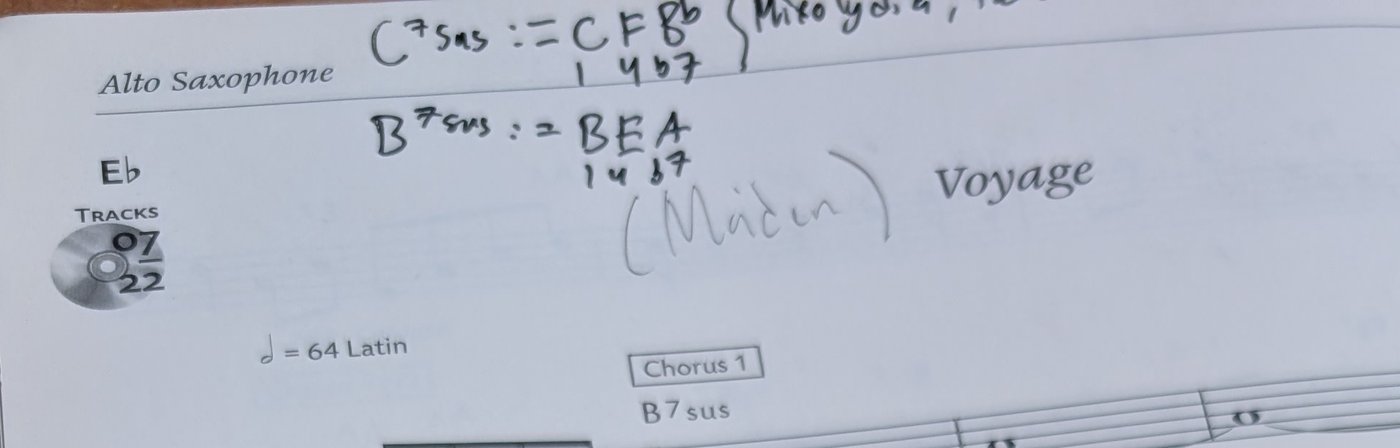
Snidero’s Voyage, Eb book, with my margin formulas.
Then I opened the Aebersold play-along (Volume 54) to the same tune, and the first chord was F#-/B. Not B anything: an F# minor chord with a B under it. Aebersold’s box says to memorize the four Dorian chord/scales. Snidero’s appendix says the scale for a 7sus is Mixolydian. And across the top of the Aebersold page, in my handwriting from a lesson with George Michael — the same George I thanked in my 2019 post on improvisation — it says E pent, A pent, B bebop.
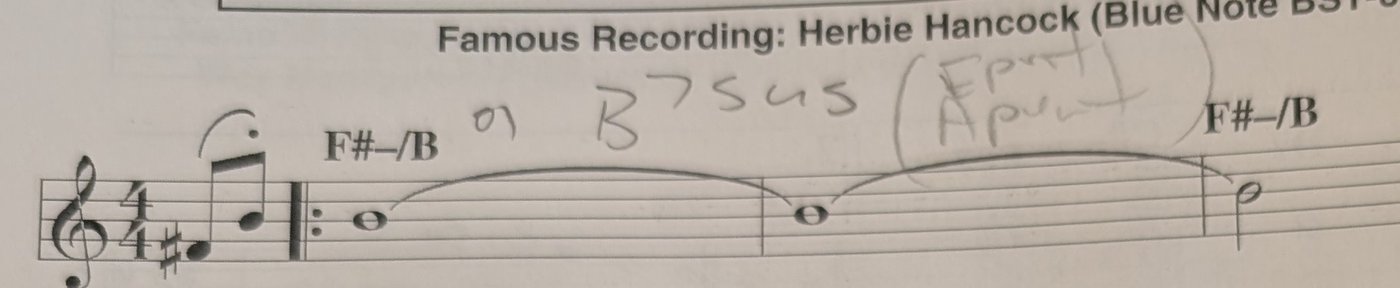
Aebersold Volume 54, Eb part: F#-/B and my pencil note.
So: is the note that matters an E or an F#? Is the scale Dorian, Mixolydian, or a pentatonic? And in the back of my head, a rule from another teacher years ago: Lydian dominant is the default on dominant chords, Mixolydian only for the real V7. Was I supposed to be thinking Lydian here too?
Notation, so nothing is ambiguous
Two conventions: everything is in alto key (Eb), since the charts I read are Eb parts, so concert pitch is a major sixth lower; and every pentatonic is named major or minor, so my pencil’s E pent and A pent are major pentatonics — the four-sharp key signature makes E major the parent scale they are built inside.
What a slash chord actually says
A slash chord is a complete chord on the left and a single bass note on the right. F#-/B means play an F# minor seventh and put a B underneath. When the bass note belongs to the chord above it, as in C/E, it’s an inversion. When it doesn’t — B is not in F# A C# E — the stack is a new chord, and the symbol is an instruction to the rhythm section: bass on B, piano on a plain F# minor seventh above it, roughly Herbie’s left hand on the record.
Now count from B: root B, ninth C#, fourth E, fifth F#, flat seventh A. No D#, no third of any kind. That is a B7sus with the ninth on top — B9sus4. The F# that looked important is just the fifth; the third of B would be D#, and neither book has it. My margin formula was right as far as it went — one, four, five, flat seven, plus the ninth — and every one of those notes is already inside F#-/B. Snidero names the sound from the bass; Aebersold names it from the upper structure.
The chord has no third, and that is the whole point
Chord quality lives in the third. Sus replaces the third with the fourth. In classical harmony that’s a suspension waiting to resolve downward; in modal jazz it never resolves, and that neither-major-nor-minor float is the entire mood of Maiden Voyage. Because nothing in the chord says major or minor, the seven-note scale that fits it can be named from any of its notes without being wrong:
- From B, it’s B Mixolydian (Snidero).
- From F#, it’s F# Dorian (Aebersold).
- From E, it’s plain E major — the parent key.
Same notes either way: E F# G# A B C# D#. The mode name tells you which note you’re treating as home, the chord symbol tells you what the bass plays, and the notes don’t change.
George’s pentatonics are subsets of that same set. A major pentatonic — A B C# E F# — is the same five notes as F# minor pentatonic, and over B it gives root, ninth, fourth, fifth, flat seven: every note a chord tone. E major pentatonic is the brighter one, with the thirteenth and no flat seven. Why those two? The scale holds three major pentatonics, on the root, the fourth, and the flat seventh; the one on the root contains D#, the third the chord exists to avoid, and the other two contain no third at all. So my one four flat-seven and George’s E pent, A pent are the same fact from two sides: the notes that define the sus are the roots of the pentatonics that fit it. B bebop is that scale plus one chromatic passing tone, A#.
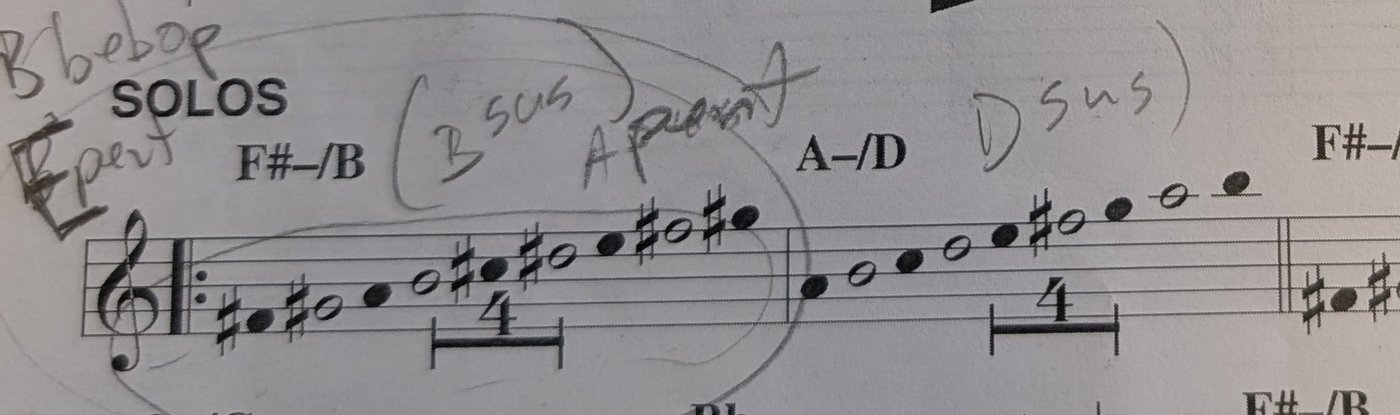
The printed F# Dorian scale under the solo section, with George’s three suggestions in my hand.
Which leaves exactly one note my three sources treat differently: D#. To Aebersold it’s the sixth of F# Dorian, a color tone; to Snidero the third of B, in the scale but not a resting tone; to George’s pentatonics it doesn’t exist. Pass through it, don’t sit on it — every voicing of this chord has an E in it, and a held D# against that E sounds like a mistake.
The sentence that stopped me
The appendix of Jazz Conception pairs each scale with a line from one of the etudes, and it insists — I had underlined it — that you hear how a line works inside the tune, because most of these scales are modes of a parent key. The example is a ii–V–I in F, where the C7 bar uses C Mixolydian but you hear F major, because C Mixolydian is the F major scale. Then comes the line I’d scrawled “what does this mean?” beside: modal tunes like Voyage are the exception, and an inside line over them sounds as if it’s in the key of the correlating scale.
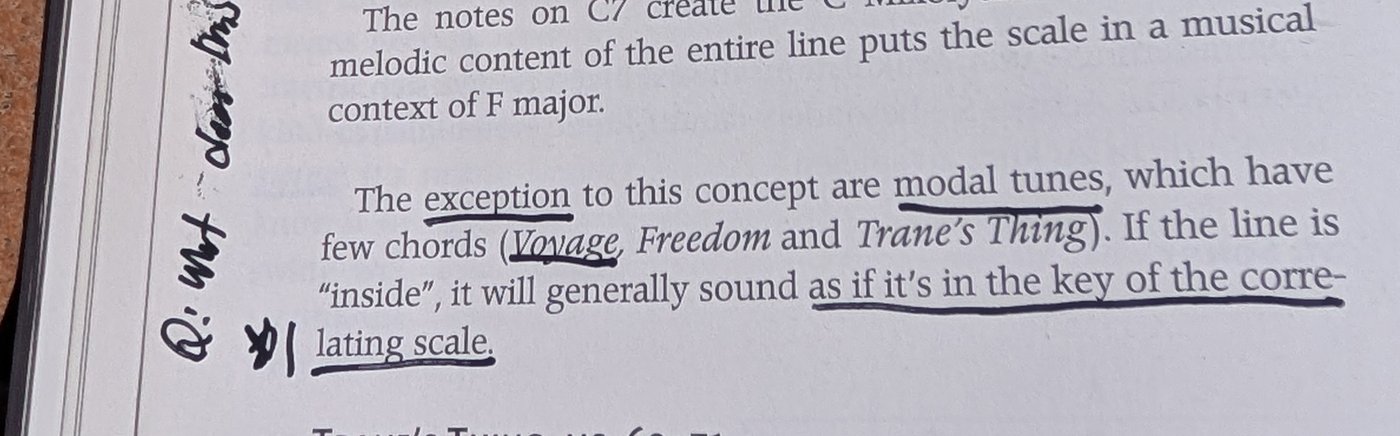
The sentence I had to sit with, and my margin note.
It took me a few readings, and the sentence is exactly right. In a functional tune the chord is a waypoint and the scale is a window onto the key. In a modal tune the chord doesn’t go anywhere; it sits for four bars and is the entire harmonic world, so the correlating scale is the key. Over B7sus you are in the key of B Mixolydian, then you modulate to D Mixolydian for four bars. A modal tune is a chain of short keys.
That reframing changed how I hear the form: the A section’s only harmonic event is a minor-third shift from the E major parent scale to the G major one, and the bridge is two fresh parent scales, F and then Ab.
Lydian dominant, Mixolydian, and one question about the fourth
Now the older rule. It’s a real rule about a real problem — the problem just doesn’t exist here. On a dominant chord that has a third, say B7 (B D# F# A), the tensions that sound good sit a whole step above a chord tone. The natural fourth E sits a half step above the third: it rubs, and it makes the chord sound suspended, dissolving the dominant quality. That’s the classic avoid note. Lydian dominant (B C# D# E# F# G# A) replaces E with E#, so all seven notes become usable — which is why modern teaching calls it the default for a dominant chord standing on its own.
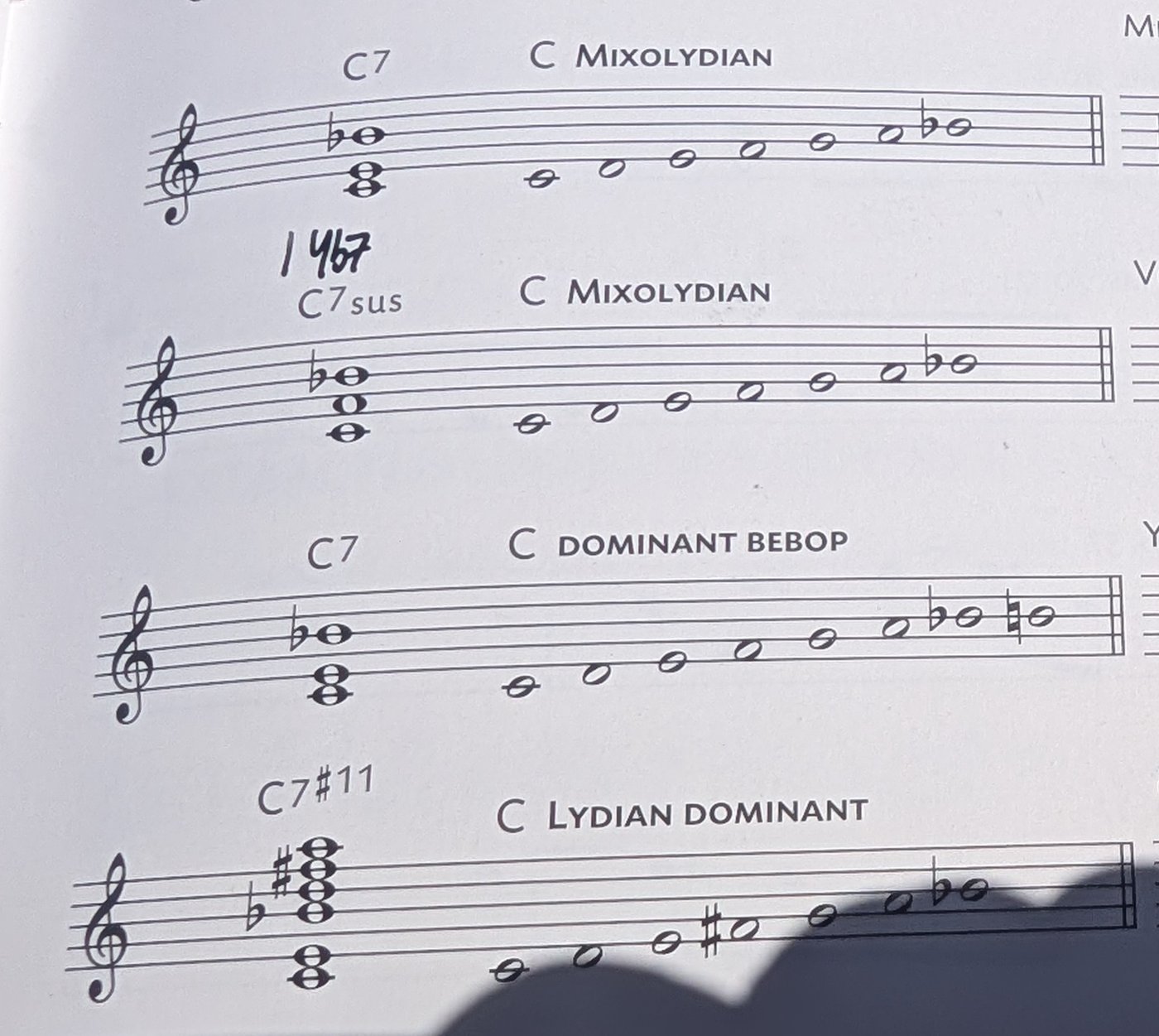
Snidero’s scale page: Mixolydian for C7 and C7sus, Lydian dominant only for C7#11.
When the V7 actually resolves, the story flips: that “avoid note” E is the tonic you’re about to land on, and Mixolydian on B7 is literally the E major scale. Lydian dominant there would hand you E#, the raised tonic of the key you’re heading to — color, not the home scale.
So the single question that decides it: does anyone want the natural fourth? If the chord wants it (a sus), Mixolydian. If the key wants it (a V7 going home), Mixolydian. If nobody wants it — a dominant going nowhere, with a third to clash against — raise it, and that’s Lydian dominant. A sus chord is the one case where the question never comes up, because the fourth is the chord. So B7sus takes B Mixolydian in every context, which is why Snidero prints Mixolydian under C7sus and reserves Lydian dominant for C7#11.
One caveat worth naming: Snidero’s page lists Mixolydian for plain C7 as well — the bebop-era, key-centered view, where the Lydian-dominant default is the modern one. Neither is wrong. Lines that run through a key favor the first habit; standalone dominants and vamps favor the second.
The lesson
The two books were never in conflict. I was confusing a name with a note. The chord symbol names the bass, the mode name names the home note, the pentatonic name names a subset of the parent scale. Once you know the chord has no third, all the names collapse into one sound, and the only real decision left is how much to lean on D# — which is not much.
That is enough for a Sunday afternoon.
If you’d like to cite this post:
@misc{miranda2026maidenvoyagesus,
  author = {Miranda, Brando},
  title  = {One Chord, Three Names: What Maiden Voyage Taught Me About Sus Chords},
  year   = {2026},
  month  = {September},
  howpublished = {\url{https://cs.stanford.edu/people/brando9/2026/09/06/maiden-voyage-sus-chords.html}},
  note   = {Blog post}
}
Acknowledgments
Thanks to George Michael for the lesson that put E pent, A pent, B bebop on the page, and to the earlier teacher who gave me the Lydian-dominant rule that turned out to be the right rule for a different chord.