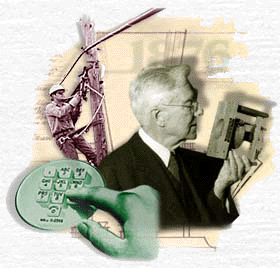
 Since the beginning
of time, mankind has been sprinting to find the most convenient, efficient and inexpensive
method to convey their ideas. The invention of the telephone in 1876 brought forth a
revolution in communication. It spread a web of instantaneous information across towns,
then a continent, then the world, and has greatly accelerated economic development. The
development of the Internet over the past 30 years has sparked innovation and
Since the beginning
of time, mankind has been sprinting to find the most convenient, efficient and inexpensive
method to convey their ideas. The invention of the telephone in 1876 brought forth a
revolution in communication. It spread a web of instantaneous information across towns,
then a continent, then the world, and has greatly accelerated economic development. The
development of the Internet over the past 30 years has sparked innovation and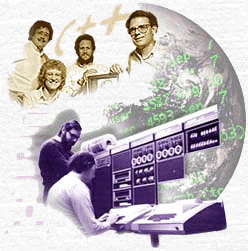 challenged technicians all over the world. In the beginning, the
Internet was government funded. But today, as the Information Super Highway becomes more
of a tool for businesses and personal users, the cost is shifting. As technology
increases, and the Internet becomes more ubiquitous in everyday life, evaluating how
important such a service is to individuals becomes a key issue for Internet providers.
challenged technicians all over the world. In the beginning, the
Internet was government funded. But today, as the Information Super Highway becomes more
of a tool for businesses and personal users, the cost is shifting. As technology
increases, and the Internet becomes more ubiquitous in everyday life, evaluating how
important such a service is to individuals becomes a key issue for Internet providers.
Everyday People
If not handled correctly, changing a system of communication with a userbase of an
estimated 10 million people world-wide could very easily cause chaos. The proposed plans
for pricing change will force consumers to think differently about how they use the
Internet. The surprise for most users, instead of the change in pricing levels (cost  will most likely increase slightly), will be the change in pricing schemes.
Charging users according to their packet usage is going to cause a fair amount of
confusion as a result of their unfamiliarity with the technical aspects of the
Internet.Users will be quick to learn that the frequency with which they use the Internet
pales in comparison to the actual types of data transfer in which they engage. Email and
FTP (File Transfer Protocol) will require minimal packet usage while video conferencing
and voice messaging typically tend to monopolize a data link greatly. Consequently, the
latter will cost more. Many of the more advanced features of the Internet (CU-SEE-ME video
conferencing, IPhone audio conferencing, etc) require hundreds of thousands of times more
packets than regular text transfer. As the cost for this particular use of the Internet
increases, people will be less apt to experiment in such areas. And as we all know, the
traffic on the Internet increases and decreases at a directly proportional rate with
congestion. Decreased packet usage encourages decreased prices.
will most likely increase slightly), will be the change in pricing schemes.
Charging users according to their packet usage is going to cause a fair amount of
confusion as a result of their unfamiliarity with the technical aspects of the
Internet.Users will be quick to learn that the frequency with which they use the Internet
pales in comparison to the actual types of data transfer in which they engage. Email and
FTP (File Transfer Protocol) will require minimal packet usage while video conferencing
and voice messaging typically tend to monopolize a data link greatly. Consequently, the
latter will cost more. Many of the more advanced features of the Internet (CU-SEE-ME video
conferencing, IPhone audio conferencing, etc) require hundreds of thousands of times more
packets than regular text transfer. As the cost for this particular use of the Internet
increases, people will be less apt to experiment in such areas. And as we all know, the
traffic on the Internet increases and decreases at a directly proportional rate with
congestion. Decreased packet usage encourages decreased prices.
The Economy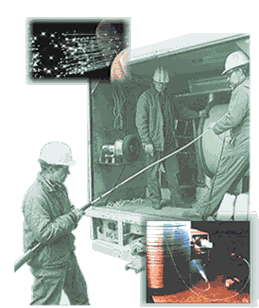
Today there is an extreme push for fast, inexpensive data links for home users and businesses. With the implementation of a pricing structure that focused on packet usage, the demand for high speed cable connections would increase dramatically. For instance, an ISP is only given so much bandwidth, depending on their uplink. The amount of packets they are able to transfer at any given time is dependant on the speed of their connection. As you increase the amount of bandwidth, the number of possible transferred packets increases as well. It is now cheaper for them to send each individual packet. As a result of this, users connected to said ISP can transfer packets for a cheaper price. As businesses and users find that audio and video transfer over the Internet is very expensive, instead of decreasing their usage, they will inevitably push for bigger and faster data pipes. Technology will increase, and prices will fall. Such a shift in pricing could very easily stimulate this growth in technology.