Two proposed plans for pricing the use of the internet are usage-based pricing and
"smart market". Usage based pricing is a mechanism by which the user pays
for use in terms of number of packets sent and received over the network.
"Smart Market" is a system which attempts to create a true free market of the
internet. Whereas in the former scheme prices are set and are the same for all user,
in the later the user can choose to connect to different service providers, pay different
amounts per regular service and can decide to pay more per packet to ensure it's delivery.
Usage-based pricing scheme was introduced by Richard J. Edell, Nick McKeown and Pravin P.
Varaiya.
System Specifications
 | No changed to existing Internet protocols. |
| Due to the extent of system, bridges and routers that currently use the internet protocol, an addition of a pricing mechanism cannot changes the existing protocol. |
| No changes to existing applications |
| Many applications such as ftp, email, gopher and Netscape are in widespread use today and collectively contribute to most of the traffic on the Internet. A billing system should be able to meter should be able to meter traffic for these and other existing applications without change to these applications. |
| User Involvement |
| For the billing to take place the system must know the identity of the user. In addition it must be able to obtain explicit approval form the user before proceeding to retrieve information. |
| Exact Pricing |
| The charges should be exact and not based on traffic sampling. The system should also be able to provide accurate and credible on-line feedback for the user as they consume resources. |

Basic Operation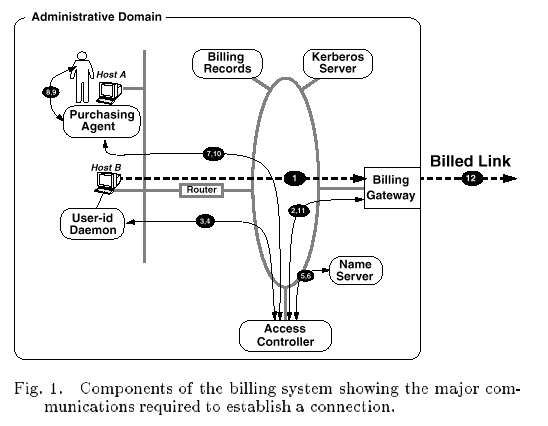
- A user attempts to establish a TCP connection
- A Billing Gateway (BGW) identifies the originating user.
- The system contacts the user to check that they want to establish the connection and are willing to pay for the service.
- The BGW now performs it's job of metering the traffic.
System Specifications
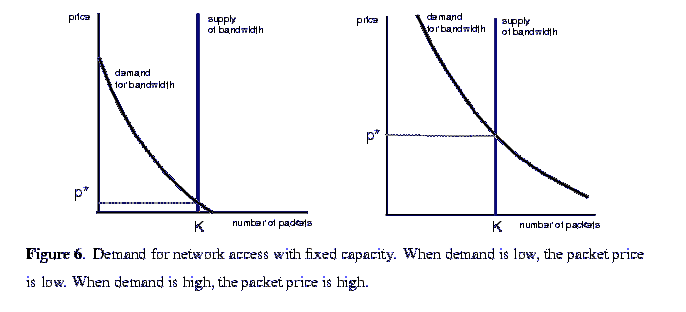
| A packet charge close to zero when the network is not congested. |
| This is since the incremental cost of sending a packet when the network is not congested is close to zero. |
| A positive packet charge when the network is congested. When the network is congested there is the price of delaying other packages in order to send another. If a sent packet is more 'important' it will cost more to send. |
| A fixed connection charge that differs form institution to institution. The connection charge will depend on the type of connection provided. This charge is used to pay for the initial investment in the network, maintenance, and expansion of the capacity of the network. |
Basic System Operation
- Flat connection fee is charged as it is today.
- When the network is not congested no charges will be made for sending a packet.
- Each packet would have a "bid" field to indicate how much the consumer is
willing
to pay to send the packet. Typically users will have default bids, and when a packet is
more important they will override the default bid with a new one. - The network admits only those packets with a bid that exceeds the current
cutoff
amount. - The charge will be made by the cutoff amount rather than by the actual bid.