History
In the late 1960s the U.S. Department of Defense formed the Advanced Research Projects Administration (ARPA). This organization developed the ARPAnet which linked together universities and defense contractors via a computer network. ARPA developed the TCP/IP protocol as the standard protocol used on the ARPAnet and any network that used TCP/IP could also communicate with the ARPAnet. This formed an internet of TCP/IP networks. Around 1985 The National Science Foundation (NSF) formed the NSFNET which adopted the TCP/IP protocol. The NSFNET served as a high speed backbone for the Internet. On April 30, 1995 the NSFNET ceased operation and now traffic in the United States is carried by privately operated backbones. A good timeline of the Internet's history can be found here.
Cost Of The Internet
It is difficult to estimate the total cost of the Internet because the Net is made up of so many other networks all over the world and many of them are private. We can, however, look at the costs of the NSFNET because it was a public network and NSF had financial figures about the costs. The NSF paid 11.5 million dollars to run the NSF backbone. Another 7 million dollars was paid to subsidize the various regional networks for a total of almost $20 million. At the time there were about 20 million users on the Internet and each user was connected to the NSFNET in some way. Thus the NFS funding amounted to about $1 per user. This number is actually lower than the actual cost of the network because it does not include the public funds that came from state governments and state universities. The estimate is that the $20 million dollars from the NSFNET is about 10 percent of the total cost of the Internet.
Current Pricing Policies
Currently the primary pricing mechanism on the Internet is connection based pricing. Users pay a fixed monthly fee for unlimited access to the Internet. The price varies depending on the speed of the connection. For most end users of the Internet, they use analog modems and dial up to their Internet Service Provider (ISP). The table below shows some sample prices of various nation-wide ISPs for analog dial up access:
ISP Price Variation
ISP |
Monthly Cost for Unlimited Use |
Maximum Modem Speed |
| Prodigy | $19.95 | 56kbps |
| CompuServe | $24.95 | 56kbps |
| America On-Line | $21.95 | 56kbps |
| Netcom | $24.95 | 56kbps |
| GTE Internet | $1995 | 56kbps |

For about $20 per month excluding telephone line charges a user can access the Internet as much as he wants using current analog modem technology. GTE Internet also offers ISDN at $39.95/month for 128kbps but this does not include telephone company charges. Universities and corporations usually pay for high speed digital lines such as T1 or T3 connections. T1 lines have a bandwidth of 1.544 Mbps and cost from $500-$1000 per month. T3 lines have a bandwidth of 43 Mbps and cost around $5000/month or more. For more ISP prices, click here.
Congestion
Congestion became a severe problem in 1987 when the NFS backbone was only using 56kbps transmission lines. NFS upgraded their backbone to T1 lines (1.544 Mbps) to solve the problem. During that time the majority of traffic on the Internet consisted of e-mail and other simple text. The following are links to graphs. The one on the left shows the number of bytes transferred over NFSNET from 1993 to 1995. The link on the right shows the projected traffic through 1997 (Click to enlarge).
1993 - 1995 1997

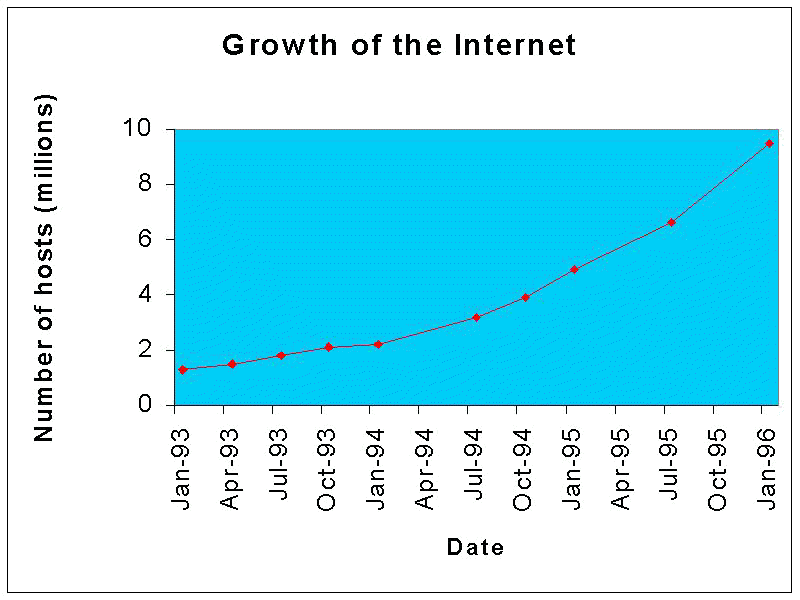 The growing
number of users on the Net is making congestion a major problem with the existing
bandwidth. The graph to the left shows the growth in the number of computers on the
Internet. The World Wide Web makes it easy to transfer high resolution graphics along with
text on the Internet. Users are also taking advantage of other multimedia content such as
digital video conferencing across the Internet. These applications take up considerably
more bandwidth and as the growth of the Internet continues, the congestion problems will
continue.
The growing
number of users on the Net is making congestion a major problem with the existing
bandwidth. The graph to the left shows the growth in the number of computers on the
Internet. The World Wide Web makes it easy to transfer high resolution graphics along with
text on the Internet. Users are also taking advantage of other multimedia content such as
digital video conferencing across the Internet. These applications take up considerably
more bandwidth and as the growth of the Internet continues, the congestion problems will
continue.