19th Century - The Origins of Surveillance
Wiretapping was perhaps the earliest form of surveillance and began during the Civil War when both the Union and the Confederacy tapped into each other's telegraph lines and copied down the messages. Eventually anyone with a portable key set and knew Morse code could listen in to messages that were being sent, as well as send messages of his own.
Major Henry Young of the Union army, towards the end of the war, directed his scouts to commandeer enemy captured telegraph lines and misdirect supply trains intended for General Lee's starving army.
Eventually the invention of the telephone ended all of this, because lots of information was transferred at a very rapid rate so that spies couldn't just listen in and copy down the information as it was being transferred.
In 1877, Thomas Edison invented the phonograph, an acoustic instrument designed to record and replay sound. However, such a device was not portable enough to tap into other people's telephone lines and could only be used to record face-to-face conversations.
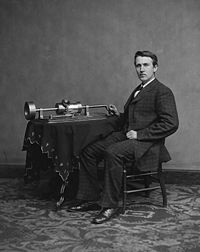
Edison with his phonograph
http://en.wikipedia.org/wiki/Phonograph
Valdemar Poulsen invented what was the first instance of magnetic wire recording in 1989, with the development of the Telegraphone. Initially, the telegraphone was intended and used for office workers and secretaries to dictate. This early device would be hooked into telephone lines. The American Telegraphone Company (ATC) realized that such a device could be used for surveillance, and marketed the product as a means of recording the calls of other people. Eventually, this simple technology would lead to more sophisticated means of recording such as magnetic tape recording. On the other hand, the telegraphone was eventually all but abandoned as the American Telegraphone Company went bankrupt.
|