[1]
The United States’ submarine power in the Pacific led the Allied forces’ victory in World War II. After the attack on Pearl Harbor, the only means of carrying the war to the Japanese was with submarines (it is interesting to note that the Japanese attack almost entirely missed the United States submarine base; the fleet was largely left unharmed and ready for the ensuing retaliation and Pacific war. This is historically regarded as a serious mistake in Japanese war tactics).
On the afternoon of December 7, 1941 the following order was issued by the Admiral R. Stark, Chief of Naval Operations in Washington:
"EXECUTE UNRESTRICTED AIR AND SUBMARINE
WARFARE AGAINST JAPAN.”
This page is designed to explain the Submarine aspect of this order, and detail the rest of Allied Submarine forces.
The
United States submarines were so effective in the Pacific that after the war,
when German Vice Admiral Wenecker was asked what he considered to be the
reasons for Japan’s devastating
loss, he replied: “Japanese overconfidence, underestimation of the enemy,
overextended supply lines… [But] by far the worst were the attacks of the
highly efficient American submarines on merchant shipping…” Indeed, the U.S.
Submarine Service accounted for 54% of the more than 10 million tons of
Japanese military and merchant shipping lost during the war. This is impressive
when viewed against the fact that the submarines accounted for a mere 1.6% of
all U.S. Navy forces engaged in the Pacific theatre. The Submarine Service was
initiated in August 1941 with the launching of USS Gato, the class of submarines which achieved the most progress
in the early U.S. submarine war. Later 122 submarines of the similar but
thicker-hulled and deeper-diving Balao-class
were added.
A total of 73 Gato class submarines were produced between 1941 and 1945, with 19 sunk. 121 Balao class were produced, with 10 sunk. Since there is such an abundance of submarine models within these classes, this website cannot do justice to the variety of the U.S. Submarine forces. Instead, the following are images of examples of each of the two classes:
USS Drum (SS-228).
Type: Gato.
Displacement: 2410 tons (submerged)
Length: 312 ft; Beam: 27 ft; Draft: 15 ft
Speed in knots: 20.75 surfaced, 8.75 submerged
Test depth: 300 ft; Crew: 65-74
USS Blenny (SS-324). Type: Balao.
Displacement: 2391 tons (submerged)
Length: 312 ft; Beam: 27 ft; Draft: 15 ft
Speed in knots: 20.75 surfaced, 8.75 submerged
Test depth: 400 ft;
Crew: 75-80
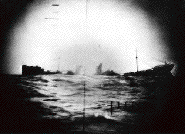
Though submarines consisted of only a marginal portion of of the U.S. Navy during World War II, but their payoff was significant: submarines sunk over 30 percent of Japan’s navy, including eight aircraft carriers. More importantly, they were the main contributor in the strangling of the Japanese economy—over 60 percent of the Japanese merchant marine. This is interesting: U.S. subs did to Japan exactly what German subs wanted to do to Britain. At left is an image of a torpedoed Japanese merchant ship sinking in the Pacific, photographed through the periscope of USS Thresher (SS-200).[4]
The overall effect of the U.S. advantage was troubling for
Japanese soldiers. According to the Cyberspace Association of United States
Submariners, the Japanese had such a deep hatred for the U.S. submariner that
terrible tortures and beatings were brought upon them in P.O.W. camps. There is
even evidence of alleged “cannibalism practiced by
the Japanese Camp Commanders” (http://www.subnet.com/CAUSS/wwii.htm).
Through USS Thresher’s periscope.
The Pacific region was the prime area of combat for the United States Submarine Service in WW II—they saw action in the Atlantic, but only in a very limited way, and they showed far fewer successes, mainly due to poor torpedo performance. The Atlantic region was dominated by British submarines. The coverage of British submarines extended throughout the Mediterranean, the Indian Ocean and Far Eastern waters. In all theatres of war, the British submarines were assisted by naval forces from the Netherlands, Norway, Poland, Greece, Yugoslavia and the Free French forces. However, perhaps a more important element of British involvement with submarines is their successful defense from the German U-boat. Read about the U-boat here.
An interesting fact about
the British submarines is that they were not air conditioned! In addition to
the heavy stressors of war, British submariners had to cope with the extreme
discomfort of heat in the small, cumbersome spaces of a war
submarine—especially in places like the almost unbearably humid Malacca Straits
or the Indian Ocean!
Most of Britain’s submarines were lost in the war: 73 out of 270 to be exact. Almost all of these lost submarines were “with all hands,” meaning fully-manned—meaning a total of over 2000 men. The U.S. Navy lost 52 submarines sunk and 3,506 men died in those boats. These boats and crews left port and never returned. Their final resting place, and the circumstances surrounding their fate is, for the most part, unknown.
In the Submarine Service, veterans refer to these boats and men as being on “Eternal Patrol.”
A poem written by Leslie Nelson Jennings is addressed to those submariners who have gone on Eternal Patrol. It is called “Lost Harbor”:
There is a port of no return, where ships
May ride at anchor for a little space
And then, some starless night the cable slips,
Leaving an eddy at the mooring place...
Gulls, veer no longer. Sailor, rest your oar.
No tangled wreckage will be washed ashore.