The
Higgins Boat
“Andrew Higgins is the
man who won the war for us.”
-President Dwight D. Eisenhower, 1964 interview
The President went on to explain: “If Higgins had not designed and built those LCVPs (Landing Craft, Vehicle and Personnel), we never could have landed over an open beach. The whole strategy of the war would have been different.” And as Colonel Joseph H. Alexander, USMC (Ret) said, “The Higgins boats broke the gridlock on the ship-to-shore movement. It is impossible to overstate the tactical advantages this craft gave U.S. amphibious commanders in World War II.”
Clearly, the half-wood half-steel “smallboat” meant a lot to the War. These assault or LCVP boats would land troops and material on invasion beachheads. Their designer, Andrew Higgins, a fire-tempered Irishman who drank whiskey like a fish, was originally building oil-prospecting wooden boats in Louisiana. Once the war broke out, he was positive there would be a need among the U.S. Navy for thousands of small boats—and was also sure that steel would be in short supply. In an common moment of eccentricity, Higgins bought the entire 1939 crop of mahogany from the Philippines and stored it on his own.
Higgins’
expectations were right, and as the war progressed he applied for a position in
Naval design. Insisting that the Navy “doesn’t know one damn thing about small
boats,” Higgins struggled for years to convince  them
of the need for small wooden boats. Finally he signed the contract to develop
his LCVP.
them
of the need for small wooden boats. Finally he signed the contract to develop
his LCVP.
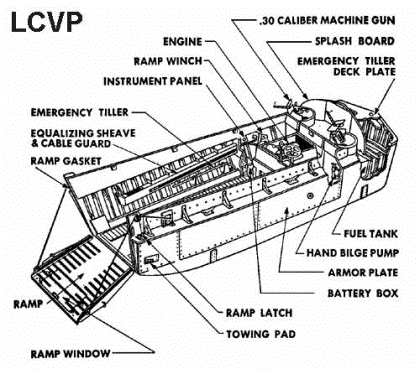
Employing more than 30,000 for an integrated workforce in New Orleans (pictured at left[1]). Higgins employed blacks and women among them, which was uncommon practice at the time. This force eagerly began mass-producing the “Higgins boats,” which were 36’3” in length and had a beam of 10’10”. Their displacement when unloaded was 18,000 lbs., and they could maintain a speed of 9 knots. They were defended by 2 .30 caliber machine guns, and could carry 36 combat-equipped infantrymen or 8,000 pounds of cargo. For a detailed picture of a Higgins boat’s anatomy, see the image below. Along with the help of other American factories, Higgins produced 23,398 LCVPs during the War.
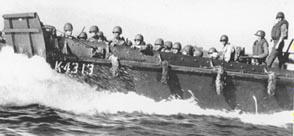
During the Normandy Invasion on D-day, the Higgins boats landed troops from the 1st Infantry Division directly into the sandy teeth of the most heavily fortified German sector—Omaha beach.

Much of the information on this page came from an article by Mike Whaley, located at: http://www.softwhale.com/history/D-Day/Higgins-boats.htm