Idea of Visual Perception
Human Perception
Computer vision is all about trying to make a computer take in an image and make
sense of it. Just like you can look around at something or some things and make
judgments about what you see, we'd like a computer to be able to do the same
thing. This process of seeing may not seem like a difficult task at all. If you
were asked to write a 25 page
paper or watch a sunset, chances are you'd pick watching the sunset. Despite
this fact, seeing is not really as easy as we may think it is. It comes easily
to us because it is an unconscious process, whereas writing, for example, takes
conscious effort. In viewing an image, the retina of the human eye performs the
equivalent of close to ten billion calculations per second before sending that
image to the optic nerve. It contains about one hundred million rods and cones,
and the eye itself contains four layers of neurons other than the retina. In
addition, an image is hardly simple itself: as M. Waldrop describes in his book
Man-Made Minds, "depending on what part of [a picture] you're looking at,
the actual intensity of light and color at your chosen point is a function of the
color and texture of [that part], the orientation of the patch of surface, the
color and intensity of the lighting, the direction of the lighting, the
transparency of the intervening atmosphere, the position of shadows, ad
infinitum." (Waldrop 89) Moreover, the eye does not simply scan over an image
and ignore the consequences (like the passive operation of a camera) -- instead
it analyzes the information it receives as well. The human visual process
determines whether a small object in its line of sight is actually small or just
far away by processing information about a 2-Dimensional picture to a 3-D form.
It can also recognize a type of object regardless of what form it may be in -- a
small chair, a swivel chair, a purple chair, an armless chair, etc. are all
perceived as chairs. Humans can also perceive from memory. If you're driving at
night and an oncoming car's headlights impair your ability to see the road, you
can continue driving because you can remember where the road is supposed to be.
Or, if somebody throws a ball into the air and sunlight blocks your view of it,
you don't walk away assuming it's disappeared forever -- you know it will come
back down. Clearly, millions of years of evolution have created a visual process
that is extremely intricate.
As a result, teaching a computer to see in the same way that humans see is not an easy project.
- The Dorm Room Example

Take a look at this picture of a dorm room. We can immediately identify most
things in it, from the mess on the floor to the lamp in the corner. A computer
has no abilities like that. It can't even tell that this is a room -- it's just a
series of pixels.
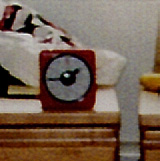
To be more specific: consider this one element of that picture. As humans, we can
instantly identify it as a clock... but how did we do it? What would you tell a
computer that the features of a clock were, to help it identify one? Think about
what it is that tells you this is a clock. Most likely, you would say it has a
familiar, clock-like rectangular shape and size, an hour and minute hand, and most importantly, it has
numbers that you know tell time.
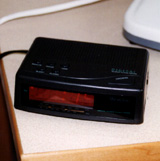
But what about this picture? It too is a clock, but compared to the first clock,
it has a different, round shape, it's smaller, and it doesn't even have the same
number set-up. It is a completely different representation of a clock from the
previous picture, yet you know this, too, to be a clock.
Think again in terms of a computer, not a human, viewing these two pictures. We
'teach' the computer that the image in the first picture is a clock. Then when
the computer is later shown the second picture and asked to identify the image,
it gets confused. This issue is a simple example of a very complex problem in
the field of computer vision. We have so many different representations and
variations of one given object that it is close to impossible to get a computer
to learn them all. Consider programming a computer to recognize any given type
of automobile. The task is enormous.
The Sensory Equation
The problem inherent in computer vision, in fact, the very purpose of the field,
is to recover information about the world from sensory input. This can be thought
about as a formula: S = f (W). Our sensory information is a function of the world
around us. What humans take for granted, and what the field of Computer Vision
struggles to make machines do, is the reverse: W = f -1(S) -- understand the world
from sensory information.
Back to the Table of Contents.