|
Sample Elementary School Curriculum
Investigations in Number, Data, and
Space: Turtle Paths
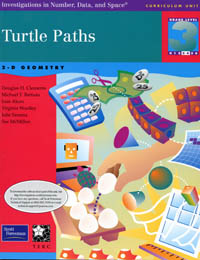 While
standard elementary school math curricula generally do not cover computer
programming in any significant way, the recent Investigations
in Number, Data, and Space series published by Pearson Scott
Foresman approaches basic geometry using Logo to supplement paper-and-pencil
exercises. Here, we examine the "Turtle Paths" unit in the
Investigations third grade curriculum as an example of the integration
of programming into pre-existing course material. While
standard elementary school math curricula generally do not cover computer
programming in any significant way, the recent Investigations
in Number, Data, and Space series published by Pearson Scott
Foresman approaches basic geometry using Logo to supplement paper-and-pencil
exercises. Here, we examine the "Turtle Paths" unit in the
Investigations third grade curriculum as an example of the integration
of programming into pre-existing course material.
Jointly developed by Pearson
Scott Foresman and TERC (a non-profit organization originally named
Technical Education Research Centers), the Investigations series
does not have an independent programming unit at the third grade level
but rather introduces students to programming as part of a unit on angles
and distances. Specifically, the "Turtle Paths" unit teaches
a variant of the Logo programming language entitled Geo-Logo to introduce
"rotation and reflection, coordinate geometry, the propeties of
2-D shapes, and angles" (I-9). The teacher's guide for this unit
explains that the curriculum is based on studies indicating that children
learn geometry by action rather than visualization. For this reason,
watching the Logo turtle move, as well as participating in kinesthetic
activities, supports the more traditional lesson plans and appeals to
different learning styles. TERC presents a series of studies
confirming the effectiveness of the teaching strategies employed in
the Investigations series.
Additional advantages of
using Geo-Logo, according to the teacher's guide, include:
- While hand-drawn diagrams
can be difficult to evaluate, a series of Logo commands are less ambiguous,
allowing teachers to more easily identify "differences in students'
conceptions" (19)
- Geo-Logo appeals to students
interested more in art than science, since they are directing the
turtle to draw.
- Students must be able
to "verbalize" their commands, rather than having only an
intuitive understanding of the geometry they are studying.
- Geo-Logo emphasizes construction
over recognition.
Programming exercises in
this curriculum designed to appeal to younger students include the following:
- A student is asked to
"come to the front and be a robot," physically acting out
the steps that the Logo turtle eventually will follow (7). This activity,
variations on which are used in several curricula for computer science
at all levels of instruction, helps students conceptualize the level
of detail required to write programs. Additionally, it provides an
example of the type of kinesthetic learning encouraged by the Investigations
curriculum.
- In the "Commanding
the Turtle" exercise, students direct the Logo turtle to retrieve
a toy from a simple maze and bring it back to the center of the maze.
This exercise motivates learning the syntax of Logo with a more concrete
goal than constructing some geometric figure.
- Students expand their
knowledge by starting with simple 90-degree turtle turns and progressing
to more angles when they discover that it is not possible to draw
a triangle using only these turns.
Other interesting components
of the Investigations curriculum pertaining to early computer
science education include:
- Special attention is directed
toward appealing to a "linguistically diverse classroom"
consisting of both native and non-native English speakers. The concept
of a "command" in Logo is generalized to the formation of
commands in the English language, providing a short supplementary
English lesson.
- Instructions are provided
for teachers with limited computing resources; effective methods are
explained for dealing with classrooms with only a few computers as
opposed to a lab.
- A detailed instruction
manual for teachers using Geo-Logo is provided for teachers less experienced
with computer programming.
Overall, the Investigations
provides a simple introduction to the algorithmic thought process with
little emphasis on programming syntax or methods. Such a curriculum
could be useful for schools seeking to use programming to supplement
pre-existing lesson plans rather than teach computer science as its
own subject area. These activities support computer science curricula
indirectly, since they instill confidence in students hesitant to learn
more complex programming techniques by starting with a relatively simple
language. On the other hand, however, Investigations' lack of
focus on programming techniques implies that it does little to directly
support the introduction of more complex programming languages in later
years.
|


