
Mills College, a private, all-women’s liberal arts college in Oakland, California, was the first women’s college to offer an undergraduate degree in computer science and to establish a department of computer science and mathematics. Mills "recognizes that role stereotyping often undermines the confidence of women in their daily ability to engage in the disciplines of mathematics and computer science and other fields of science. Encouraging mathematical and computer literacy, along with 'hands on' experience with computer systems, is part of the college's continued effort to increase the analytical and technical competence of its women graduates."
Mills' graduate programs in computer science are particularly effective in drawing women to computer technology. Unlike most Masters of Science degrees, Mills' Masters of Arts in Interdisciplinary Computer Science (ICS) program provides graduate-level computer science education without requiring a technical undergraduate degree. Applicants typically have liberal-arts backgrounds, with only basic programming and mathematics coursework:
[The ICS] degree program allows students with limited technical backgrounds to gain knowledge of computer science and how computers interact with other disciplines. Students achieve perspective on the strengths and limitations of computers, and to understand what advances are needed in computer science to solve theoretical problems in a variety of fields. The innovative aspect of the program that distinguishes it from other master's programs in computer science is its focus on relating computers to other disciplines where the combination has potential for great impact.
The ICS program also strongly encourages the students to interact closely with faculty. Graduates typically enter positions in industry or education that require bridging the gap between the developers and end users of computer technology.
Mills’ New Horizon program, through which students receive a graduate certificate in computer science, is targeted even more specifically towards providing computer science education to women who lacked technical education in their undergraduate studies:
Since the fall of 1982, Mills has provided a certificate program in computer science for college graduates, especially women, who find barriers in their path to graduate study in computer science, to employment, or to advancement based on a lack of exposure to sophisticated computer concepts. This small program offers support and personal attention while students study complex computer science concepts. It also provides substantial opportunity for hands-on experience with computer programming on a variety of computer systems. Each student's course of study is tailored to individual needs and includes independent study options.
Stanford's top-rated undergraduate computer science program encourages women indirectly, by offering a challenging, fast-paced introductory course sequence that assumes no prior programming experience. Students without programming experience typically take a two-quarter sequence in software engineering fundamentals, while students with strong computer backgrounds take a faster-paced, one-quarter sequence. Thus, after only one extra quarter, students who entered Stanford with no programming experience are equipped with the fundamental skills necessary to keep pace alongside their more experienced classmates.
In addition, Stanford offers means of support specifically for women in engineering and computer science through student-run organizations:
Women In Computer Science (WICS) is a student-organized group aimed at providing a support base for both undergraduate and graduate women involved with computer science. WICS organizes activities to which prominent women from industry and academia are invited to discuss the growing role of women in computer science.
The Women's Science and Engineering Network (WSEN) pairs up female undergraduate and graduate students in computer science in mentor relationships. The Stanford Undergraduate Engineering Handbook states, "networking with a mentor promotes self-confidence and assertiveness; helps students clarify their career goals; teaches them how to interact better with faculty and peers; and offers them the support needed for dealing with the pressures of being in male-dominated fields." The Stanford WSEN brings undergraduates and graduate students and faculty through receptions, workshops, panel discussion, quarterly programs, field trips, as well as a monthly newsletter. Such relationships not only encourage female undergraduate students by having graduate students act as role models, but also graduate students feel more respected and accomplished (Pearl, et al. 52).
Stanford's Society of Women Engineers (SWE) chapter is also particularly active in encouraging women in engineering disciplines, including computer science. A national organization, SWE's main objectives include:
Stanford was recognized as SWE's "Best National Student Section" in 2000. Stanford SWE conducts weekly meetings, offering networking and support opportunities, and featuring guest speakers who present on topics ranging from resume writing and interview tips to technical presentations to balancing career and family issues. Stanford SWE hosts an annual industry banquet, various outreach programs, and offers mentoring to its members.
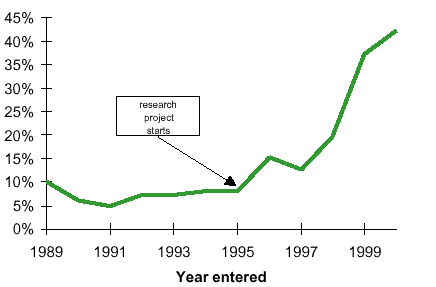
Allan Fisher and Jane Margolis, from the School of Computer Science at CMU, tested methods of closing the computer science gender gap in higher education over a period of several years. Fischer and Margolis discovered that while male students cite enjoyment of computing as the primary reason they chose to major in computer science, female students also cited safe and secure employment, outside encouragement, flexibility of the field, and the ability to combine computers with other interests as major reasons. Considering these factors, CMU adopted a more contextual approach to Computer Science Education to help bridge the gender gap:
Fisher and Margolis’ research also lead CMU to start a summer conference in which high school teachers discuss the gender gap in computer science and what can be done about it while preparing to teach Advanced Placement courses in computer science. Preliminary statistical analysis shows increased numbers of women considering computer science as a potential major, especially at Carnegie Mellon, due to positive teacher experiences at the program.
Finally, the CMU admissions office began placing increased weight on leadership skills and other non-academic factors when looking at computer science applicants, as well as communicating to prospective applicants that prior programming experience is not necessary for admission.
U.C. Berkeley's Computer Science Reentry Program is aimed at making graduate study in computer science possible for women with a bachelor's degree in another field, especially those talented in mathematics or science but not specifically prepared for graduate work in computer science. Most participants in the program have worked in a related industry and are of 25 years of age or older.
Program participants take regular computer science courses along with undergraduates, and in addition receive a host of support services. Women in the program are provided with "faculty advising, access to other Berkeley faculty and graduate students, and support services tutoring, study groups, discussion groups, technical and career-oriented seminars, strategies for applying for graduate programs and scholarships, and facilitation of discussion and exploration of topics related to the reentry experience" (Leveson, 1989).
Over 170 women have participated in the program since the program's inceptions in 1984. Women whose undergraduate degrees were in fields like biology, drama, classics, and mathematics have gone on to attain Ph.D.'s in computer science. Unfortunately, the passage of Proposition 209 in California has imposed legal constraints on the Computer Science Reentry Program. The program is currently under review. (Humphreys.)