Region Control Demystified
The final aspect of copy and access protection employed by Digital Video Discs is a
technology known as region (or territorial) control. This technology basically
divides the world into a number of regions (6 for DVD), only allowing discs sold in a
certain region to be played on players manufactured in a given region.
The reason this technology exists is because movie studios typically sign complicated
cross-licensing deals for international distribution: for example, Disney might allow
Warner Bros. to release Disney's movies on DVD and VHS in Asia, while Disney would receive
the right to distribute Warner Bros. films in Europe. This allows each studio to only
concentrate on one international division, rather than a global divisions for each company,
which technically should trickle down, resulting in cheaper prices for DVDs and movie
tickets all around the world.
| When DVDs from the wrong region are inserted into a DVD player, an image
like the one on the right will be seen, indicating that the player is incapable of playing
back the disk (this image is taken from a Japanese Playstation 2 trying to load the US version
of Terminator 2: Judgement Day). |
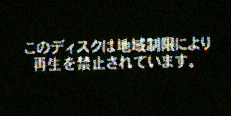
Kono disku-wa... not exactly T2 |
Problems
The biggest problems surrounding region control on DVDs can be summarized in three words: Eyes Wide Shut.
Among true fans of film (currently the majority of DVD owners), the only legitimate way to watch movies is as they were
originally created. Typically, this isn't a problem: virtually all DVDs are released in their original aspect ratio (normally
widescreen), and quite a few have director's cuts available that add footage back to the movie that the director initially
wanted. Unfortunately, there are several cases where getting the original version of a work is impossible in the United States.
Warner Bros., the distributor for Eyes Wide Shut, decided that the North American release should be identical to
the R-rated theatrical release, meaning that the oft-criticized digital modifications in the orgy scene would remain.
However, much to the distaste of fans, the original version of Eyes Wide Shut, sans the digital mangling, would be
released in Japan, with Warner having no plans for a second, unedited, US release. This means that the only way to see
Eyes Wide Shut as Kubrick had initially planned it would be to purchase the Japanese import. Unfortunately, due to region
control, even if you were willing to pay the outrageous cost for international shipping, you still wouldn't be able to play
Eyes Wide Shut unless you were also willing to purchase a Japanese DVD player, and have that shipped across the Pacific Ocean,
too.
The DMCA
As with all the copy/access protection technologies, the DMCA rears its ugly head with region control, basically making it
illegal to market or create a device that bypasses region control. When the Apex AD-600A DVD player was released in the
United States, information that it had a "secret menu" which allowed users to disable region control quickly spread throughout
DVD enthusiast circles, making the Apex player the most popular DVD player ever sold at Circuit City, with units selling faster
than they could be restocked all around the country. After the MPAA confirmed the Apex "hack," Apex was forced to redesign
their menus so that the "secret menu" (in all actuality, it was just a debug menu that still had working entry codes) was no
longer accessible. Currently, first-generation Apex players sell for between 150% and 300% their original MSRP on eBay.
| Similarly, when it was discovered that Sony's new Playstation 2 console could play non-Japanese DVDs by pressing down
and circle on the controller, Sony Computer Entertainment rushed to correct the problem. Within 1 month of the release of the
Playstation 2, new DVD player software was released (and the old DVD player software was recalled) that disabled this work-around.
Unsurprisingly, only a handful of the owners of the first 1.4 million Playstation 2s bothered returning their buggy 1.0 drivers
for the "upgraded" 1.01 drivers. |
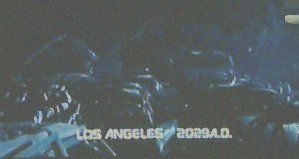
Same Playstation 2, same Terminator 2 |
Territorial controls have existed in some form since the days of the Nintendo Entertainment System. The Japanese counterpart to the
NES, the Famicom, used a completely different cartridge design than what was used in the NES, rendering games incompatible unless
a converter was used. Nintendo employed a similar technique with the Super NES / Super Famicom. Similarly, Sega and Sony included
region control chips in their CD-ROM based consoles (the Saturn, Dreamcast, Playstation, and Playstation 2). Unsurprisingly, all these
controls have been circumvented, and none of the three companies has made any attempt at all to curb importers from purchasing
Japanese software. Since similar licensing agreements exist in the console video game industry (ex: Square Co., Ltd. gave Sony
distribution rights for its blockbuster hit Final Fantasy VII in the United States and Europe in exchange for preferred
developer status). Since numerous comparisons are drawn between the movie and video game industries, one really has to wonder why the
MPAA so voraciously attacks region control work-arounds in DVD players while console manufacturers seem to let it
slide. With unbreakable region control, many titles that may never make it to US shores are forever left outside of our grasp - in
addition to the correct version of Eyes Wide Shut, quite a few Japanese anime, Hong Kong action, and Italian films will probably
never play from sea to shining sea. Thanks to the DMCA, this is arguably government-supported censorship. While the market for
imported DVDs is small compared to the market for domestic DVDs, the fact that movie studios now have the ability to prosecute
customers for finding ways around MPAA censorship is very alarming.