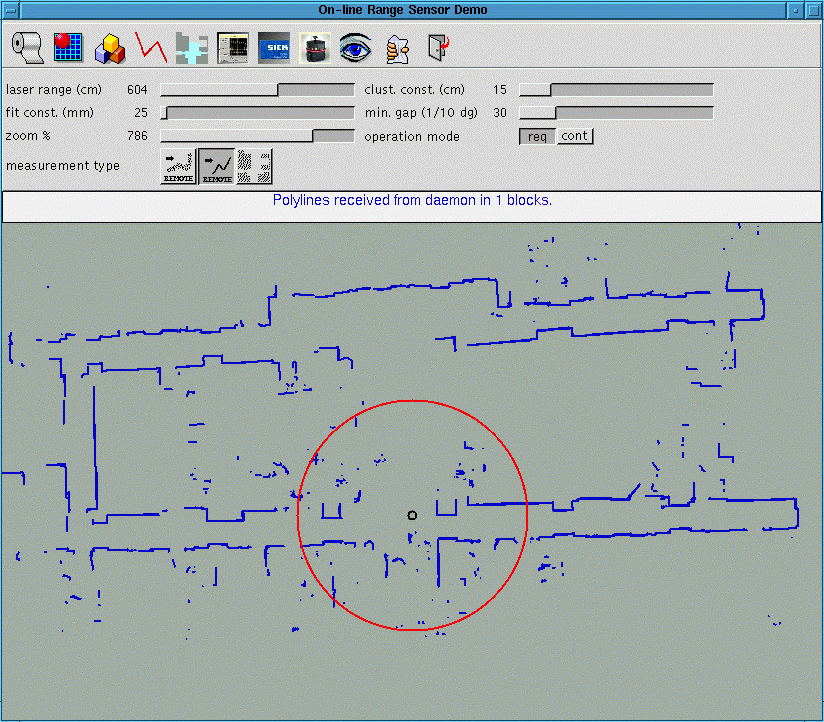
In a typical building, there are chairs, table legs, boxes. It is reasonable not to integrate these objects as part of the main building map, as they can be moved around or even completely removed. We started developing heuristics to recognize these small objects, to create a separate map for them, and to adjust the next-best-view algorithm so that it ignores these artifacts.
We performed a full mapping of our laboratory---mostly made of two parallel corridors about 45 meters long (see http://underdog.stanford.edu/tmr/monthly/oct99/labmap.gif). This real life experiment showed a number of small problems in the details of our algorithms that we addressed: we improved the way the union of safe regions was computed, and the matching of partial maps.
We created several 3D scans of a part of the lab and stitched them together to obtain a single 3D map. (See images at http://underdog.stanford.edu/tmr/monthly/oct99/3dscans.html.)
We demonstrated on a scenario with real robots that our planner was superior to a pure visual-servoing tracker: the latter loses the target when it goes around a corner, but the planner, who has a knowledge of the map of the building, is able to plan ahead, apparently going away from the target, but only in order to be ready to see what is behind the corner before the target reaches it. (See the two movies at http://underdog.stanford.edu/tmr/monthly/oct99/ser-pla.html.)
In order to improve the speed of the observer controlled by the planner, we are experimenting with a new way to handle the planner commands. Instead of first reaching the position requested by the planner, then rotating towards the requested direction, we compute a trajectory that does both at the same time.
We started implementing one of our strategies for two observers to track two targets with promising results.
We presented our map building system at the Ninth International Symposium on Robotics Research at the beginning of the month ("Planning Robot Motion Strategies for Efficient Model Construction", by H.H. Gonzalez-Banos, A. Efrat, J.C. Latombe, E. Mao, T.M. Murali).
We presented our work at the TMR quarterly meeting in San Antonio.