Recent News
[click here to zip down to the
schedule of public lectures]
Happy MMXX to all!
I celebrated my 82nd birthday this year by watching a marvelous
video of
the Czech première of my multimedia composition
Fantasia Apocalyptica.
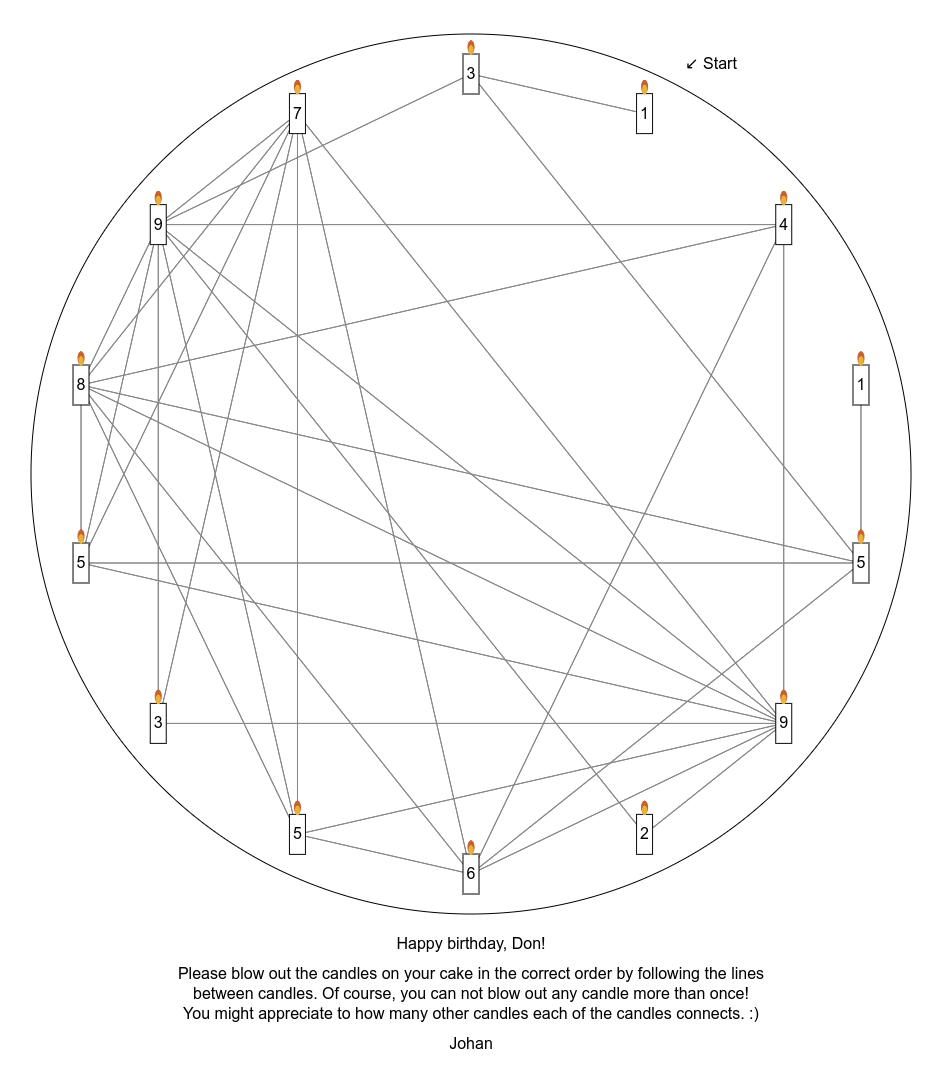
A happy π birthday
Johan de Ruiter sent me a
great puzzle
for my birthday this year!
However, a sad word ladder
VIRUS - VIRES - FIRES - FIRER - FIVER - FEVER
(fortunately my family and I are still healthy)
Oral histories
Since that was my 10001st birthday (in base three),
I'm still operating a little bit in history mode.
People have periodically asked me to record some
memories of past events --- I guess because I've been
fortunate enough to live at some pretty exciting times,
computersciencewise. These after-the-fact recollections
aren't really as reliable as contemporary records; but
they do at least show what I think I remember. And the
stories are interesting, because they involve lots of
other people.
So, before these instances of oral history themselves begin to fade
from my memory, I've decided to record some links to several that I
still know about:
-
Interview by Philip L Frana at the Charles Babbage Institute, November 2001
-
transcript of OH 332
audio file (2:00:33)
-
Interviews commissioned by Peoples Archive, taped in March 2006
-
playlist for 97 videos (about 2--8 minutes each)
-
Interviews by Ed Feigenbaum at the Computer History Museum, March 2007
-
Part 1 (3:07:25)
Part 2 (4:02:46)
(transcript)
-
Interview by Marc Pachter, filmed by Peter Badge, commissioned by the Heidelberg Laureate Forum, November 2016
-
video (57:02)
-
Interview by Susan Schofield for the Stanford Historical Society,
May 2018
-
(audio files, 2:20:30 and 2:14:25; transcript)
-
Interview by David Brock and Hansen Hsu about the computer programs that I wrote during the 1950s, July 2018
- video (1:30:0)
(texts of the actual programs)
-
Wide-ranging interview filmed in my office at home by Lex Fridman, March 2019
- video (1:45:55);
audio podcast
- (And he filmed a sequel, in a Foster City motel(!), in July 2021)
- video (2:21:26);
audio podcast
-
See also a podcast in ACM's new "ByteCast" series (interviewed by Rashmi Mohan on 12 March 2020)
- audio podcast (28 min) and transcript
-
More recently, Susan D'Agostino prepared a profile that features story-telling:
- Quanta magazine (16 April 2020)
-
Still more recently, Brady Haran posted a “Numberphile Podcast”
based on a conversation we had on 16 April 2023
- A Very Bad Estimator (54:26)
-
Still still more recently, Xinxin Zhang of Cover News (thecover.cn, 封面)
interviewed me at the end of May 2024
- her story (in Chinese)
-
Still still still more recently,
Juan Moyano interviewed me on behalf of
Neardearla 2025
- The Art of Donald Knuth, part 1 (41:33);
part 2 (45:34)
-
And most recently—24 October 2025—Parsa Khazaeepoul and Zack Axel hosted a
Questions & Answers session as part of Georgia Tech's “Turing Minds” series
Some extended interviews, not available online, have also been published
in books, notably in Chapters 7--17 of
Companion to the Papers of Donald Knuth
(conversations with Dikran Karagueuzian in the summer of 1996), and
in two books by Edgar G. Daylight,
The Essential Knuth (2013),
Algorithmic Barriers Falling (2014).
Also, if you want to see older stuff, a good list of “historic”
interviews has been compiled by volunteers at the
TUG website.
Progress on Volume 4B
The fourth volume of
The Art of Computer Programming
deals with Combinatorial Algorithms, the area of computer science
where good techniques have the most dramatic effects. (I love it
the most, because one good idea can often make a program run
a million times faster.) It's a huge, fascinating subject, and I
published Part 1 (Volume 4A, 883 pages, now in its fourteenth printing)
in 2011.


Two-thirds of Part 2 (Volume 4B) are now available
in preliminary paperback form as
Volume 4, Fascicle 5 (v4f5): “Mathematical Preliminaries
Redux; Introduction to Backtracking; Dancing Links”; and
Volume 4, Fascicle 6 (v4f6): “Satisfiability”.
Here are excerpts from the hype on the back cover of v4f5 (382 pages):
This fascicle, brimming with lively examples, forms the first third
of what will eventually become hardcover Volume 4B.
It begins with a 27-page tutorial on the major advances in probabilistic
methods that have been made during the past 50 years, since those theories
are the key to so many modern algorithms. Then it introduces the
fundamental principles of efficient backtrack programming,
a family of techniques that have been a mainstay of combinatorial computing
since the beginning. This introductory material is followed by an extensive
exploration of important data structures whose links perform delightful
dances.
That section unifies a vast number of combinatorial algorithms by showing
that they are special cases of the general XCC problem --- “exact
covering with colors.” The firstfruits of the author's decades-old
experiments with XCC solving are presented here for the first time,
with dozens of applications to a dazzling array of questions that arise in
amazingly diverse contexts.
The utility of this approach is illustrated by showing how it resolves and
extends a wide variety of fascinating puzzles, old and new. Puzzles provide
a great vehicle for understanding basic combinatorial methods and
fundamental notions of symmetry. The emphasis here is on how to create new
puzzles, rather than how to solve them. A significant number of leading
computer scientists and mathematicians have chosen their careers after
being inspired by such intellectual challenges. More than 650 exercises
are provided, arranged carefully for self-instruction, together with
detailed answers---in fact, sometimes also with answers to the answers.
And here is the corresponding hype on the
back cover of v4f6 (310 pages, to appear soon in its fifth printing):
This fascicle, brimming with lively examples, introduces and surveys
“Satisfiability,” one of the most fundamental problems in
all of computer science: Given a Boolean function, can its variables
be set to at least one pattern of 0s and 1 that will make the function true?
Satisfiability is far from an abstract exercise in understanding formal
systems. Revolutionary methods for solving such problems emerged at the
beginning of the twenty-first century, and they've led to game-changing
applications in industry. These so-called “SAT solvers” can now
routinely find solutions to practical problems that involve millions of
variables and were thought until very recently to be hopelessly difficult.
Fascicle 6 presents full details of seven different SAT solvers, ranging from
simple algorithms suitable for small problems to state-of-the-art algorithms
of industrial strength. Many other significant topics also arise in the course
of the discussion, such as bounded model checking, the theory of traces, Las
Vegas algorithms, phase changes in random processes, the efficient encoding of
problems into conjunctive normal form, and the exploitation of global and
local symmetries. More than 500 exercises are provided, arranged carefully for
self-instruction, together with detailed answers.
I worked particularly hard while preparing many of the new exercises,
attempting to improve on expositions that I found in the literature;
and in several noteworthy cases, nobody has yet pointed out any
errors. It would be nice to believe that I actually got the details
right in my first attempt. But that seems unlikely, because I had
hundreds of chances to make mistakes. So I fear that the most probable
hypothesis is that nobody has been sufficiently motivated to check
these things out carefully as yet.
I still cling to a belief that these details are extremely instructive,
and I'm uncomfortable with the prospect of printing a hardcopy edition
with so many exercises unvetted.
Thus I would like to enter here a plea for some readers to tell
me explicitly, “Dear Don, I have read exercise N and its answer
very carefully, and I believe that it is 100% correct,” where N is one
of the following exercises in Volume 4 Fascicle 5:
- MPR-28-29: Prove basic inequalities for sums of independent binary random variables
- MPR-50: Prove that Ross's conditional expectation inequality is sharper than the second moment inequality
- MPR-59: Derive the four functions theorem
- MPR-61: Show that independent binary random variables satisfy the FKG inequality
- MPR-99: Generalize the Karp–Upfal–Wigderson bound on expected loop iterations
- MPR-103-104: Study ternary “coupling from the past”
- MPR-114: Prove Alon's “combinatorial nullstellensatz”
- MPR-121-122: Study the Kullback–Leibler divergence of one random variable from another
- MPR-127: Analyze the XOR of independent sparse binary vectors
- MPR-130-131: Derive paradoxical facts about the Cauchy distribution (which has “heavy tails”)
- 7.2.2-75-76: Devise an algorithm that lists every n-element connected subset of a given graph
- 7.2.2-79: Analyze the sounds that are playable on the pipe organ in my home
- 7.2.2.1-29-30: Characterize all search trees that can arise with Algorithm X
- 7.2.2.1-53: Find every 4-clue instance of shidoku (4×4 sudoku)
- 7.2.2.1-55: Determine the fewest clues needed to force highly symmetric sudoku solutions
- 7.2.2.1-69: Investigate gerrymandering in Bitland
- 7.2.2.1-91: Find the longest right word stairs in WORDS(1000) and the longest left word stairs in WORDS(500)
- 7.2.2.1-103: List all of the 12-tone rows with the all-interval property, and study their symmetries
- 7.2.2.1-104: Construct infinitely many “perfect” n-tone rows
- 7.2.2.1-109: Encode any given “wordcross puzzle” as an XCC problem
- 7.2.2.1-115: Find all hypersudoku solutions that are symmetric under transposition or under 90° rotation
- 7.2.2.1-121: Determine which of the 92 Wang tiles in exercise 2.3.4.3–5 can actually be used when tiling the whole plane
- 7.2.2.1-129: Enumerate all the symmetrical solutions to MacMahon's triangle-tiling problem
- 7.2.2.1-147: Construct all of the “bricks” that can be made with MacMahon's 30 six-colored cubes
- 7.2.2.1-151-152: Arrange all of the path dominoes into a single loop
- 7.2.2.1-172: Find the longest snake-in-the-box paths and cycles that can be made by kings, queens, rooks, bishops, or knights on a chessboard
- 7.2.2.1-189: Determine the asymptotic behavior of the Gould numbers
- 7.2.2.1-196: Analyze the running time of Algorithm X on bounded permutation problems
- 7.2.2.1-215: Show that exclusion of noncanonical bipairs can yield a dramatic speedup
- 7.2.2.1-262: Study the ZDDs for domino and diamond tilings that tend to have large “frozen” regions
- 7.2.2.1-305-306: Find optimum arrangements of the windmill dominoes
- 7.2.2.1-309: Find all ways to make a convex shape from the twelve hexiamonds
- 7.2.2.1-320: Find all ways to make a convex shape from the fourteen tetraboloes
- 7.2.2.1-323: Find all ways to make a skewed rectangle from the ten tetraskews
- 7.2.2.1-327: Analyze the Somap graphs
- 7.2.2.1-334: Build fake solutions for Soma-cube shapes
- 7.2.2.1-337: Design a puzzle that makes several kinds of “dice” from the same bent tricubes
- 7.2.2.1-346: Pack space optimally with small tripods
- 7.2.2.1-375: Determine the smallest incomparable dissections of rectangles into rectangles
- 7.2.2.1-387: Classify the types of symmetry that a polycube might have
- 7.2.2.1-394: Prove that every futoshiki puzzle needs at least six clues
- 7.2.2.1-415: Make an exhaustive study of homogenous 5×5 slitherlink
- 7.2.2.1-424: Make an exhaustive study of 6×6 masyu
- 7.2.2.1-432: Find the most interesting 3×3 kakuro puzzles
- 7.2.2.1-442: Enumerate all hitori covers of small grids
Furthermore, I fondly hope that diligent readers will write and say
“Dear Don, I have read exercise N and its answer
very carefully, and I believe that it is 100% correct,” where N is one
of the following exercises in Volume 4 Fascicle 6:
- 7.2.2.2-6: Verify a certain (previously unpublished) lower bound on van der Waerden numbers
W(3,k)
- 7.2.2.2-57: Find a 6-gate way to match a certain 20-variable Boolean function at 32 given points
- 7.2.2.2-165: Devise an algorithm to compute the largest positive autarky of given clauses
- 7.2.2.2-177: Enumerate independent sets of flower snark edges
- 7.2.2.2-212: Prove that partial latin square construction is NP-complete
- 7.2.2.2-282: Find a linear certificate of unsatisfiability for the flower snark clauses
- 7.2.2.2-306-308: Study the reluctant doubling strategy of Luby, Sinclair, and Zuckerman
- 7.2.2.2-318: Find the best possible Local Lemma for d-regular dependency graphs with equal weights
- 7.2.2.2-322: Show that random-walk methods cannot always find solutions of locally feasible problems using independent random variables
- 7.2.2.2-335: Express the Möbius series of a cocomparability graph as a determinant
- 7.2.2.2-339: Relate generating functions for traces to generating functions for pyramids
- 7.2.2.2-347: Find the best possible Local Lemma for a given chordal graph with arbitrary weights
- 7.2.2.2-356: Prove the Clique Local Lemma
- 7.2.2.2-363: Study the stable partial assignments of a satisfiability problem
- 7.2.2.2-386: Prove that certain CDCL solvers will efficiently refute any clauses that have a short certificate of unsatisfiability
- 7.2.2.2-428: Show that Boolean functions don't always have forcing representations of polynomial size
- 7.2.2.2-442-444: Study the UC and PC hierarchy of progressively harder sets of clauses
- 7.2.2.2-518: Reduce 3SAT to testing the permanent of a {-1,0,1,2} matrix for zero
Please don't be alarmed by the highly technical nature of these examples;
more than 250 of the other exercises are completely non-scary,
indeed quite elementary. But of course I do want to go into high-level details also,
for the benefit of advanced readers; and those darker corners of my books
are naturally the most difficult to get right. Hence this plea for help.
Remember that you don't have to work the exercise first. You're allowed
to peek at the answer; in fact, you're even encouraged to do so.
Please send success reports to the usual address for bug reports
(taocp@cs.stanford.edu).
Thanks in advance!
By the way, if you want to receive a
reward check for discovering an error in TAOCP,
your best strategy may well be to scrutinize the answers to the exercises
that are listed above.
Meanwhile I continue to work on the final third of Volume 4B, which
already has many exciting topics of its own. Those sections are
still in very preliminary form, but courageous readers who have
nothing better to do might dare to take a peek at the comparatively
raw copy in these “prefascicles.” One can look, for instance, at
Pre-Fascicle 8a (Hamiltonian Paths and Cycles);
Pre-Fascicle 9b (A Potpourri of Puzzles).
Thanks to Tom Rokicki, these PostScript files are now searchable!
Something for music fans
Check out these videos, just posted by Jan Overduin:
Playlist
Public lectures in 2020
Although I must stay home most of the time and work on yet more books that
I've promised to complete, I do occasionally get into speaking mode.
Here's a current schedule of events that have been planned for
this year so far:
-
Friday, January 31 at 10:25am in the Clarke Center Auditorium
-
“Stratified importance sampling” (a talk for
Persi Diaconis's 75th birthday conference, open to the public)
(view slides)
(view current state of fasc9c)
(view a related PDF)
-
Tuesday, September 22 (online, part of the Virtual Heidelberg Laureate Forum)
-
Dialogue: Robert Endre Tarjan/Donald Ervin Knuth
(watch video, 58 minutes)
-
Friday, October 9 (online, Virtual Homecoming sponsored by the Alumni Association of
Case Western Reserve University)
-
accepting an award at 60th class reunion, reminiscing about college days
(watch video)
(my part starts at time 38:00)
-
sometime in October? (no, this has been postponed)
-
Participating in a performance or two of
Fantasia Apocalyptica at
First Lutheran Church, Palo Alto,
as part of their centennial celebration
-
sometime in early December? (no, there will be no Christmas lecture this year, sorry)
- A
Computer Musing
(the 26th annual Christmas lecture)
Click here for the “recent news”
that was current at the end of 2019,
if you're interested in old news as well as new news.


 Don Knuth's home page