Overview
Legged robots, unlike wheeled robots, have the potential to access
nearly all of the earth's land mass, enabling robotic applications in
areas where they are currently infeasible. However, the current control
software for legged robots is quite limited, and does not let them
realize this potential.
In the Learning Locomotion project, we seek to develop software that
significantly advances the state of the art in robotic quadruped
locomotion over rough terrain. To achieve this goal, we develop and
apply novel control and machine learning algorithms.
We gratefully acknowledge DARPA for supporting this work.
|
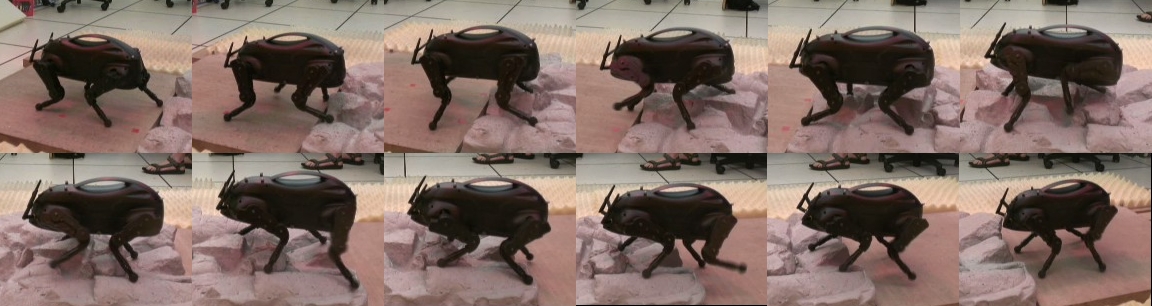
The LittleDog Robot
The robotic platform for this research is the LittleDog robot,
designed and built by Boston
Dynamics, Inc.
|
Publications
Stereo Vision and Terrain Modeling for Quadruped Robots
J. Zico Kolter, Youngjun Kim, and Andrew Y. Ng. To appear in
Proceedings of the IEEE International Conference on Robotics and
Automation, 2009. [pdf]
|
Task-Space Trajectories via Cubic Spline Optimization
J. Zico Kolter and Andrew Y. Ng. To appear in Proceedings of
the IEEE International Conference on Robotics and Automation,
2009. [pdf]
|
A Control Architecture for Quadruped Locomotion over Rough
Terrain
J. Zico Kolter, Mike P. Rodgers, and Andrew Y. Ng.
In Proceedings of the IEEE International Conference on Robotics
and Automation, 2008. [pdf]
|
Hierarchical Apprenticeship Learning with Application to Quadruped
Locomotion
J. Zico Kolter, Pieter Abbeel, and Andrew Y. Ng.
In Neural Information Processing Systems, 2007. [pdf]
|
Learning Omnidirectional Path Following Using Dimensionality
Reduction
J. Zico Kolter and Andrew Y. Ng. In Proceedings of
Robtics: Science and Systems,
2007. [pdf]
|
Quadruped Robot Obstacle Negotiation via Reinforcement Learning
Honglak Lee, Yirong Shen, Chih-Han Yu, Gurjeet Singh, and Andrew
Y. Ng. In Proceedings of the IEEE International Conference on
Robotics and Automation , 2006. [pdf]
|
|
Videos and Pictures
|
Dynamic Jumping Manuever, 12/2008.
[wmv]
|
|
Onboard Stereo Vision, 9/2008.
[mp4]
|
|
Crossing Terrains of Increasing Difficulty, 9/2007.
[mp4,
wmv]
(low-res mp4,
wmv)
|
|
Planning Before/After Learning #1, 9/2007.
[mp4,
wmv]
(low-res mp4,
wmv)
|
|
Planning Before/After Learning #2, 9/2007.
[mp4,
wmv]
(low-res mp4,
wmv)
|
|
Crossing Terrain Snapshots, 9/2007.
[jpg]
|
|
Omnidirectional Path Following, 6/2006.
[mpg,
wmv]
|
|
Learning to Balance, 6/2006.
[mpg,
wmv]
|
|
| People
Faculty:
Students:
|